22 September 2014

Lars Muhl "When Angels Fall" (1991)

When Angels Fall
release date: 1991
format: cd
[album rate: 3 / 5] [3,18]
producer: Lars Alsing, Lars Muhl
label: RCA / BMG Ariola - nationality: Denmark

Track highlights: 3. "How Many Teardrops Must Fall" - 4. "Elevator" - 5. "Two Hearts Are Better Than One" - 8. "When Angels Fall" - 11. "Gi' mig en chance"

3rd studio album by Lars Muhl following three years after King of Croon (Apr. 1988) sees Muhl in collaboration with guitarist Lars Alsing. Muhl has certainly stepped up in terms of label backing going from small Fox Records to a major international label. However, fact is that he didn't sell a lot of albums. His first two solo releases had been met by open arms, but mainly from music critics and other musicians. He was a darling of the press and of the industry but still had to prove his worth as a hit maker of albums. Yes, Lars Muhl had been involved in hit songs all over Scandinavia, but mainly as songwriter and composer of music for others. It seemed he still struggled in finding his very own original expression. His first album out was a turn to pop crooner, something he elaborated on the follow-up, which put him somewhere in a strange category where people would associate his music with David Bowie on one side of the spectre and via his crooner appeal - also with Bing Crosby.
Anyway, When Angels Fall wasn't the commercial breakthrough many expected would come, sooner or later, because fact is, Muhl was a highly estimated artist. His name had become a guarantee stamp for quality and hit song potential. The album is, however, strangely anonymous. It's pop, but where King of Croon also contained synth pop with a grandiose Phil Spector-like production, this one comes short on most parameters. Muhl wants hard to present hit songs but the album feels like a move in the wrong direction. The front cover depicts Muhl with flowers in his arms as hints to Morrissey and his ability to write ballads and romantic love songs all while posing casually dressed with a cigarette in hand, as if not going all the way, or being both sincere and yet half-hearted, and that sort of fits the music here more precisely than desired, I guess. When Angels Fall attempts to be a soft, romantic affair but the central actor appears detached, and where does this put the artist, Lars Muhl? He's even stronger placed in nowhere land, or on his private isolated island. The songs point in many directions. Some are slow blue-eyed ballads, others are uptempo and club-like rockers delivered with a sneer, he knows so well from inspirational sources like Joe Jackson and Costello, but that influence simply don't fit the production or the remaining material. It seems, he still wants to break out as an international artist, who can do whatever he feels like, and get away with it. The big difference is that Costello don't sell or signal romantic love songs, and Lars Muhl just seems unable to choose which scene to play on. And then, he's not David Bowie or up there where you are actually able to pull that ambiguity off.
Worst of all, not only didn't the album provide any hits, nor did it sell that many copies, now with another commercial failure, more critics turned against his artistic profile with some referring to his singing style as whimping and whining, as a clear contrast to that of crooning. Still, Lars Muhl holds a position as an artist with great potential, but the troublesome musical career hasn't exactly welcomed him with open arms, and instead of living life in the capital or in his home town of Aarhus, he has now moved to the small island of Samsø, which could be seen as one of the first signs of not being able to fit in. He still seeks artistic recognition and a musical career and at the same time he isolates himself.
When Angels Fall is Muhl's so far least appealing album. It contains good songs and music, but overall, it's a bit of a mess and it feels half-hearted.

21 September 2014

The Prodigy "Always Outnumbered Never Outgunned" (2004)

Always Outnumbered Never Outgunned
release date: Aug. 23, 2004
format: digital
[album rate: 2,5 / 5] [2,68]
producer: Liam Howlett
label: XL Recordings - nationality: England, UK

Track highlights: 1. "Spitfire" (feat. Juliette Lewis) - 4. "Get Up Get Off" (feat. Twista) - 5. "Hotride" (feat. Juliette Lewis)

4th studio album by The Prodigy released nearly seven years after the huge success with Fat of the Land (1997). The tracks are primarily written by Howlett and several tracks are co-written with Neil McLellan who also mixes, does programming, and adds vocals to several tracks, although, he has not been adopted as an official member. Musically, this is a 'back to the basics' of techno (which has much of its origins in the US), but it's also a continued journey into sampling and with much hip hop-inspiration.
To me this was a rather disappointing release. It's put together and produced by Howlett as usual, and both Flint and Maxim's vocals are missing. However, the mix with more original techno simply ruins the 'clean' British breakbeat and big beat somewhat. Some of the tracks are mere samplings of former The Prodigy hits, i.e. track #6 "Wake Up Call" is simply too close to "Firestarter". The album had no real single hits but sold rather well. Both Q Magazine and Rolling Stone only gave it a two-stars review, and allmusic.com handed it 2,5 to this their so far lowest point, which I agree on is a mediocre output. The best tracks feature Juliette Lewis (from Juliette and the Licks) on vocal.

Rammstein "Du hast" (1997), single

Du hast, single
release date: Jul. 21, 1997
format: cd
[single rate: 4 / 5] [3,78]
producer: Jacob Hellner, Rammstein
label: Motor Music - nationality: Germany

Tracklist: 1. "Du hast (Single Version)" (5 / 5) - 2. "Bück dich (Album Version)" (3,5 / 5) - 3. "Du hast (Remix by Jacob Hellner)" - 4. "Du hast (Remix by Clawfinger)"

Single release by Rammstein and the second single issue prior to the release of the forthcoming second album Sehnsucht to be released the following month. The title track seems the same as on the album, which also goes for the second track, whereas the last two remixes offers new versions. The first and best remix by producer Jacob Hellner is an electronic big beat (The Prodigy-like) version of the single, and the last Clawfinger remix is an alt. metal hard rock version, which is a rather inferior version; however, the original version is a truly fabulous track.

20 September 2014

Dire Straits "Love Over Gold" (1982)

Love Over Gold
release date: Sep. 20, 1982
format: vinyl (6359 109) / cd
[album rate: 3,5 / 5] [3,56]
producer: Mark Knopfler
label: Vertigo Records - nationality: England, UK

Tracklist: 1. "Telegraph Road" (4 / 5) - 2. "Private Investigations" - 3. "Industrial Disease" - 4. "Love Over Gold" - 5. "It Never Rains"

4th studio album by Dire Straits. The new broader style initiated on Making Movies (Oct. 1980) is continued with the addition of more jazz rock and progressive compositions. Before making recordings for the album, two new members joined the band, Hal Lindes on guitar and Alan Clark on keyboards, and especially the latter is probably responsible for the keyboard and piano dominance on this album. My initial thoughts were bland and I thought of the album as too slow and soft but basically it's a rather strong but also the band's most progressive rock-styled album with almost no tracks below 6 minutes playing time and with the longest lasting single-track exceeding 14 minutes running time.
[ allmusic.com, Rolling Stone 4 / 5 stars ]

Van Morrison "The Best Of" (1990)

The Best Of (compilation)
release date: Feb. 5, 1990
format: cassette / cd (1998 remaster)
[album rate: 5 / 5]
producer: Van Morrison; various
label: Exile / Polydor - nationality: Northern Ireland, UK

Compilation album and first 'real' best of album by Van Morrison. 'Real' because a number of earlier releases exist such as several issued by Bang Records, but also releases on Bellaphon, London, Nova, DGR, Castle Communications, and Deram mostly just featuring songs from his first recordings while being signed with Bert Berns' label Bang and all released without Morrison's consent except for those released on Decca while playing with Them.
Apparently, Morrison had been reluctant wanting nothing to do in releasing a best of album in the first place, and only long discussions with his record label paved way for a release comprising some 25 years - from his first releases with "Baby Please Don't Go" and "Gloria" with Them from 1964 to "Have I Told You Lately" and "Whenever God Shines His Light" from his most recent album, Avalon Sunset (1989). Nearly all 20 songs (from 13 albums) are written entirely by Van himself, which really is an amazing collection of songs.
The album became and immediate commercial as well as critical success relaunching his musical career and it has also become his best-selling album to date. It peaked at number #4 in the UK and as number #1 in Australia. Since then, he has released another two best of albums: Best of - Volume 2 (1993), and the double album Best of - Volume 3 (2007).
I purchased the album on cassette upon its release in 1990, and it's definitely my most played cassette. My only complaint about this, is the record label's decision not to enlist the songs in chronological order; however, thanks to Morrison's varied stylistic moves and influences over nearly three decades, it's quite remarkable how coherent an album it is. Quite usually, best of albums are just not as good as the individual quality of songs but here's really an album only featuring top material that despite different styles and arrangements make up the finest whole.
Highly recommended.

Big Brother & The Holding Company "Cheap Thrills" (1968)

Cheap Thrills
release date: Aug. 12, 1968
format: cd (1999 remaster) / vinyl (2012 remaster) (gatefold)
[album rate: 4 / 5] [3,92]
producer: John Simon
label: Columbia / Music On Vinyl - nationality: USA

Key track: 4. "Piece of My Heart" (5 / 5)

2nd studio album by Big Brother & The Holding Company follows one year after the self-titled debut (Aug. 1967), and this is a different breed and what appears as a live album. In reality, it's instead the band's second studio release. Cheap Thrills is the band's most famous release and its last featuring Janis Joplin. The band members credited here are vocalist Janis Joplin, bassist & guitarist Peter Albin, bassist, guitarist & vocalist Sam Andrew, bassist & guitarist James Gurley, and pianist and drummer David Getz. Additionally, producer John Simon is also credited on piano. Compared to the uneven debut, which unfortunately wasn't given the time nor the effort the material asked for, Cheap Thrills is considerably better arranged and produced.
The album has gained iconic status primarily for the band's and in particular Joplin's performance, and it's part of numerous best-of-lists, including Rolling Stone's 500 Greatest Albums of All Time, Rolling Stone Top 100 Albums of the Last 20 Years, and "1001 Albums You Must Hear Before You Die".
Note: The cover art by 'Underground' cartoonist Robert Crumb is just as legendary as the musical content. The front cover here is a copy of the 2012 remaster, which replicates the original US cover.
[ allmusic.com 5 / 5 stars ]

19 September 2014

Big Brother & The Holding Company "Big Brother & The Holding Company" (1967)

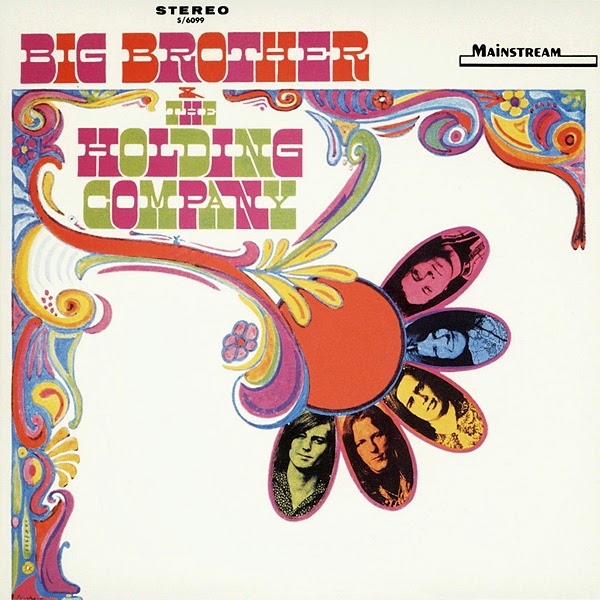
1968 + cd cover
Columbia Records
Big Brother & The Holding Company [debut]
release date: Aug. 1967
format: cd (reissue)
[album rate: 3 / 5]
producer: Bob Schad
label: Columbia Records - nationality: USA

Tracklist: A) 1. "Bye, Bye Baby" - 2. "Easy Rider" - 3. "Intruder" (3 / 5) - 4. "Light Is Faster Than Sound" 3 / 5) (tv performance) - 5. "Call On Me" (3 / 5) - *6. "Coo Coo" (4 / 5) - - B) 1. "Women Is Losers" - 2. "Blindman" - 3. "Down On Me" (3 / 5) (tv performance) - 4. "Caterpillar" (3 / 5) - 5. "All Is Loneliness" - *6. "The Last Time"
*Bonus tracks on 1968 reissue

Studio debut album released by Big Brother & The Holding Company originally released on Mainstream Records. The band formed in 1965 on initiative of Peter Albin (bass guitar) and Sam Andrew (guitar, vocals), and initially worked as a trio after including James Gurley on guitar and vocals. After the inclusion of drummer David Getz the quartet then needed a stronger vocal and Janis Joplin was the last to join in the early summer of 1966. The album is quite typical as an early blues rock and psychedelic rock album, and some argue that it lacks really great tracks or extraordinary performances.
Perhaps Joplin is still new to rock and her voice may lack a bit of the strength you'll find on the successor and on her masterpiece Pearl (1971). The album, however, still contains fine traces of greatness, and I find that the band appears as a tight unit of American electric blues rock with a strong original vocal. The real "weakness" of the album is the poor production sound and a lack of stylistic direction. Some tracks seem inspired by British beat, whereas others are pure (original) experimental psychedelic rock compositions, but as a whole the album comes out as somewhat unfocused. The best tracks, A6 and B6, both originally released only as singles, but these were included on the '68 reissue and are both outtakes from the original recording sessions - on newer cd issues they may be enlisted after the original tracklist as tracks #11 and #12.
[ allmusic.com 3 / 5 stars ]

org. cover
Mainstream Records

18 September 2014

Robyn "Body Talk Pt. 3" (2010) (ep)

Body Talk Pt. 3, ep
release date: Nov. 22, 2010
format: cd
[album rate: 3,5 / 5] [3,62]
producer: Klas Åhlund
label: Konichiwa Records - nationality: Sweden

Track highlights: 1. "Indestructible" - 4. "Get Myself Together" - 5. "Stars 4-Ever"

Studio ep release and final part of the "Body Talk"-series is a minimised album compared to the first two parts, although, they weren't exactly 'normal' full-length albums. The two former parts may still be regarded as actual albums, I think. Credentials for production and songwriting follows the same recipe as the other releases with Klas Åhlund as major partner and driving force. Robyn's initial announcement about releasing three mini-albums was somewhat altered after Body Talk, Pt. 2, which wasn't released until September. Instead, she now spoke of a full-length Body Talk album to end the year; however, this seems like her first take on a compromise. Part 3 is the first natural ep release as it's almost just half the length of the two first single parts with a running time below 19 mins. It contains five tracks, and it's released - on the date - simultaneously with a promised full-length Body Talk album containing selected tracks from all three mini-albums, which then would be regarded as her seventh studio album.
Part 3 full-fills her self-professed idea of releasing 3-albums-a-year in 2010, but it also seems like a compromise in the sense that it's not made as extensive as the two former releases - perhaps she was running out of time, or ideas?? Fact is, the first part wasn't released until June and it should take her another three months to release part 2, and as she was occupied doing live concerts everywhere in a year where she intended to release three albums writing and recording songs while touring... well, needless say, it would take quite an effort, and here as the calendar runs out of months, she could realise her project issuing a single ep, although that would be a bit like letting air out of a balloon, so she also handpicked songs from the three releases and issued the Body Talk album, which in essence feels like a compilation more than a studio album, but as I said, I think that explains the compromise.
After all, Part 3 sums of the year quite nicely. It continues the style of the two predecessors and basically lands somewhere in between in more than one sense. It's styled like a mix of Part 1 and Part 2 as it contains a stronger electropop-style than Part 2, and it also contains some of the same hooks and sparkle that one finds on the first part, and to end the project right, she has included the strong single "Indestructible" in the traditional dance-pop version, which is found on Part 2 in an acoustic version. All in all, it's not the blast it started out as, but it's still more than Okay. Five tracks would be an awesome release thinking of the quality from Part 1, but this ep still contains two obvious fillers, which perhaps points to the conclusion that Robyn was running out of both time and ideas.
[ SputnikMusic, Gaffa.dk 4 / 6, Express.co.uk 3 / 5 stars ]

Gang of Four "The Peel Sessions Album" (1990)

The Peel Sessions Album (compilation)
release date: 1990
format: cd (SFRCD107)
[album rate: 3,5 / 5] [3,42]
producer:  Bob Sargeant (1-8); Phil Stannard (9-11)
label: Strange Fruit - nationality: England, UK

Compilation album as well as a heavily enhanced reissue of the original The Peel Sessions album from 1986. The album nicely compiles three John Peel-sessions for the BBC on one album - the first four tracks are identical to the original 1986 ep release, then follows four tracks from the second session recorded Jul. 2, 1979, and ending with the last three tracks from the band's third session, recorded Mar. 9, 1981.
This is a fine compilation.

Grant Hart "Intolerance" (1989)

Intolerance
[debut]
release date: Dec. 12, 1989
format: vinyl / cd
[album rate: 3,5 / 5] [3,72]
producer: Grant Hart
label: SST Records - nationality: USA


Studio album debut by Grant (Vernon) Hart following the disbandment of Hüsker Dü (1988) released on SST Records. The album is released six months following former band mate Bob Mould's solo debut, but Hart actually released the three-track ep 2541 already in Oct. '88, and most of the recordings for this album were already finished at an earlier stage, but due to financial difficulties, the label were initially only able to release the ep. Actually, Hart had first signed with Rough Trade for the album release, but when they closed its US division he returned to the first label of his former band only to find that they also experienced an economic detour.
In the band Hüsker Dü, Hart was drummer, vocalist and songwriter, and on this he also proves his worth as multi-instrumentalist as he's the only musician credited on the album. In their band, Bob Mould easily drew people's attention to him - together with bassist Greg Norton they represented the two faces upfront, and after the split, Mould managed to sign with a major label, while Hart stayed more in the shadow of his former band mate, which is an unfair position as he literally wrote half of the band's songs and you could add: the more challenging and complex ones.
Anyway - and all speculations about internal conflicts that split the band aside - Intolerance is Hart's solo debut and it contains ten tracks all written, composed, performed and produced by Hart on his own. Stylistically, it's primarily alt. rock incorporating folk rock with a certain influence from a singer / songwriter vault with bonds to traditional r&b. Hart is undoubtedly a gifted songwriter and also knows his instruments. Sometimes there're strong bonds to the music by his former band on the more aggressive and uptempo tracks, at other times it echoes older traditions and Grant himself at times reminds us of the singing style of Eric Burdon (of The Animals) ("All of My Senses") or Van Morrison ("You're the Victim").
The album was generally met by positive reviews, although, the promotion part certainly suffered from being released on a minor label. The song "2541" has been covered by many artists over the years, and a fine version is included on Robert Forster's covers album I Had a New York Girlfriend (1994). The album production lacks dynamics and sounds s bit dated, also for a late 80's album, but the songs are there, and Hart more than anything demonstrates his songwriter talent. I concede to the conclusion made by Stewart Mason of Allmusic.com when he says: "It didn't get the press attention of Bob Mould's much slicker Workbook, out around the same time, but Intolerance is probably the better album".
Recommended.
[ allmusic.com 4 / 5 stars ]

The Sharing Patrol "Day After Yesterday" (1986)

Day After Yesterday [debut]
release date: 1986
format: vinyl (SOUND 104)
[album rate: 3,5 / 5]
producer: Søren Poulsen and Sharing Patrol
label: Sound Of Music - nationality: USA

Full-length studio album debut by Seattle-founded American new wave and indie rock trio The Sharing Patrol consisting of songwriter Johnny Sangster on lead vocals and guitar, Jonathan Stibbard on drums, keyboards and backing vocals and Danish bassist Henrik Tuxen also on backing vocals. The band debuted in Seattle with cassette only EP release They Share and We Share and Then We All Go Out for Supper in 1984 (on independent label PopLlama) as a trio with Sangster, Stibbard and Lou Alexander. However, Sangster and Stibbard relocated to Denmark and re-started the band now with Tuxen on bass.
They play an energetic blend of new wave and rock & roll with bonds to traditional British beat.

17 September 2014

Joe Strummer and The Mescaleros "Global A Go-Go" (2001)

Global a Go-Go
release date: Jul. 24, 2001
format: digital
[album rate: 3,5 / 5]
producer: Scott Shields, Martin Slattery, Joe Strummer, Richard Flack
label: HellCat Records - nationality: England, UK

Track highlights: 1. "Johnny Appleseed" - 2. "Cool'n'out" - 3. "Global A Go-Go" - 4. "Bhindi Bhagee" - 6. "Mega Bottle Ride" - 9. "Bummed Out City"

2nd studio album by Joe Strummer and The Mescaleros and Strummer's 4th full solo album. The album continues from Rock Art and the X-Ray Style (1999) but with a more world music and rock & roll attitude about it that makes it sound more like a modern roots rock release. My first verdict was one of luke-warm feelings but it's actually much better than that. It's varied, complex and hard-rocking in it's own original way using elements from a huge melting pot of styles and genres, but without losing direction. Roger Daltrey of The Who feature on vocals on track #3 and Strummer wrote all lyrics except for track #11.
[ allmusic.com 3 / 5 stars ]

My Bloody Valentine "Tremolo E.P." (1991) (ep)

Tremolo E.P., ep
release date: Feb. 20, 1991
format: cd (CRESCD085)
[album rate: 4 / 5] [3,75]
producer: My Bloody Valentine
label: Creation Records - nationality: Ireland

Track highlights: 1. "To Here Knows When" (4 / 5) - 2. "Swallow" (5 / 5) - 3. "Honey Power" (4 / 5) - 4. "Moon Song"

4 track ep with one track from the forthcoming album Loveless to be released in November.
It's quite evidently much closer in style to the bands coming second full-length album than the debut Isn't Anything album from '88. The multi-layered dynamics are already here, but the production sound is somewhat murkier than what would succeed. Anyway, this is a very fine ep and the three tracks you won't find on Loveless could easily have been included on that without lowering the quality or the status of that album. "Swallow" has a beautiful ethereal touch to it, which makes me think of Lush cloned with Cocteau Twins, and "Honey Power" sounds much like the first drawing to the great opening track "Only Shallow" on Loveless, but as is the case with this song, all tracks generally lack the extra dimension of clever production.
[ allmusic.com 4,5 / 5 stars ]


15 September 2014

Beto Guedes "Contos da Lua Vaga" (1981)

Contos da Lua Vaga
release date: 1981
format: cd (2002 reissue)
[album rate: 4 / 5] [3,76]
producer: Beto Guedes
label: EMI - nationality: Brazil


4th studio album by Beto Guedes follows two years after Sol de Primavera and is the first with himself as producer. Much as usual the majority of the songs are written by Guedes with various other co-composers like Ronaldo Bastos, Marcio Borges and Luiz Guedes. In tradition with his former releases this also contains one song written by Milton Nascimento and Fernando Brant (track #6), and ends with a song of his fathers (track #11).
"O Sal da Terra" is already a modern classic of MPB but other songs lifts this release and makes it his so far second best only superceded by Amor de Índio (1978).
Recommended.

14 September 2014

Thåström "Xplodera mig 2000" (1991)

Xplodera mig 2000
release date: Mar. 1991
format: cd (2011 remaster)
[album rate: 3,5 / 5] [3,38]
producer: Joakim Thåström & Sankan Sandqvist
label: MNW - nationality: Sweden

Track highlights: 1. "Radio Thåström" - 3. "Elektrisk" - 4. "Elvis Presley för en dag" - 6. "Miss Huddinge -72"

2nd solo studio album by Thåström originally released on Mistlur Records has the former lead vocalist of Imperiet in his so far most experimental outing. Musically, Thåström here showcases his fascination for industrial rock in what appears as a musical side-step. The album is full of industrial elements, drum machines and distorted guitars and on top of that, Thåström often sings with heavy distortion. Fjodor (Lennart Eriksson - former Ebba Grön bassist) features on vocals, but apart from his presence the album is made with several new guest artists. The album was recorded in Amsterdam to where Thåström would relocate in 1992.
Stylewise, this may sound fairly aggressive, and it may have frightened some of his stable fans as it's clearly marks a strong change of style. Some songs are in the shape of more traditional hard rock songs (e.g. "Miss Huddinge -72"), others are more harmony-based (e.g. "Elvis Presley för en dag" and "Xplodera mig") as a more distinct and familiar Thåström quality, but the overall focus is quite evidently on industrial rock, which really embodies this release.
I simply rejected the album in '91 as too experimental, too hard rock-alike and without much recognition; however, in hindsight, it's no near a mediocre release, it just never caught my attention until after I came accross the 20th anniversary remastered edition, which comes with five demo recordings as bonus tracks. The album is still not one of my favourites, but it's definitely worth looking up as it really shows Thåström's new phase with industrial rock.
After this, Thåström left Sweden and relocated in Amsterdam where he continued his musical journey with the project-band Peace, Love & Pitbulls, formed in 1992. He was not to release another solo album for the following 8½ years, which he spent entirely on music with his new project-band.

The Raybeats "Guitar Beat" (1981)

Guitar Beat [debut]
release date: 1981
format: digital (expanded reissue)
[album rate: 3 / 5] [3,18]
producer: Martin Rushent
label: PVC Records - nationality: USA

Track highlights: 1. "Tight Turn" - 2. "Big Black Sneakers" - 3. "Tone Zone" - 5. "B-Gas Rickshaw" - 6. "International Operator" - 8. "Calhoun Surf" (4 / 5) - 11. "Guitar Beat" - 13. "Holiday Inn Spain" (Bonus track)

Studio album debut by American band The Raybeats released on PVC Records and produced by British engineer and producer Martin Rushent in England. The album came out as an anachronism while the world of popular music was either pop / rock, disco, mainstream pop, contemporary r&b, new romantic, new wave, or post-punk-minded, but this is mostly pure surf rock as played primarily in the US in the 1950's. Some tracks contain elements of no wave and jazz fusion, and it's an exclusively instrumental release. I guess, most people never really knew about the album, and it was only by chance that I stumbled on it in 1982 or '83 when it was still a new album. A friend of mine had bought the album in a local record store with mostly punk rock music, and I remember finding it quite interesting but never really great, but fine enough to keep a copy on cassette for years. The version I refer to here is an extended cd with two bonus tracks. Unfortunately, they changed the original track listing, which seems like a major blunt - although, a quite typical label decision.
The Raybeats released one more album before disbanding in '84.
[ allmusic.com 4,5 / 5 stars ]

13 September 2014

Alt-J "An Awesome Wave" (2012)

An Awesome Wave [debut]
release date: May 28, 2012
format: cd
[album rate: 3 / 5]
producer: Charlie Andrew, Mark Bishop
label: Infectious Records - nationality: England, UK

Track highlights: 3. "Tessellate" - 4. "Breezeblocks" (4 / 5) - 7. "Dissolve Me" (3,5 / 5)

Studio debut album by '∆' (aka Alt-J ([Alt] + [J]) released on Infectious Records, produced by Charlie Andrew, and Mark Bishop. The band name is ∆, the symbol known as 'delta', which may be found on a Macintosh computer's keyboard by pressing the 'Alt' tab combined with the 'J' tab, hence the band-name reference to just Alt-J.
The album is an interesting experimental release into art pop and indietronica with folk and electronica elements. I really enjoy some of the tracks but also find that other compositions on the album simply elude my attention. Having said that, the unique sound and style only document that this is a band to look out for. The album generally received positive reviews by most critics but some found it touching on pretentiousness and less attraktive describing labels, however, the album was nominated and awarded the British music prize Mercury Prize Award in 2012 ahead of artists like Richard Hawley, Michael Kiwanuka, and Django Django, and it seems that in the short retrospect, the album has gained reputation.

12 September 2014

Jan Garbarek "All Those Born With Wings" (1987)

All Those Born With Wings
release date: Feb. 1, 1987
format: cd (ECM 1324)
[album rate: 4 / 5] [3,78]
producer: Manfred Eicher
label: ECM Records - nationality: Norway

Tracklist: 1. "1st Piece" (3,5 / 5) - 2. "2nd Piece" (4 / 5) - *3. "3rd Piece" (4 / 5) - 4. "4th Piece" (3,5 / 5) - 5. "5th Piece" (4 / 5) - 6. "6th Piece" (3 / 5)
* In Memory of Andrej Tarkowskij

Studio album by Jan Garbarek, as always, produced by Manfred Eicher. The album is quite original in that Garbarek is only musician on the album, which is to say he plays (uncredited) all instruments including saxophones, keyboards, guitar, percussion, voice and other.
The album was the very first full album I ever listen to with Garbarek, and perhaps therefore it's still among my favourite Garbarek albums. As said, it's also one of his more experimental studio releases. Some tracks could be labelled modern classical, others as ambient or new age but the overall style is one of contemporary jazz fusion or free jazz, which sometimes drifts too far into what sounds as mere improvisations, but here the compositions predominantly stay on a fixed course.

Miles Davis "Aura" (1989)

Aura
release date: Sep. 12, 1989
format: vinyl 2 lp (463351 1)
[album rate: 3,5 / 5] [3,44]
producer: Palle Mikkelborg
label: CBS Records - nationality: USA

Studio double album by Miles Davis following the album Amandla (May 1989), which in many ways was a close follow-up to the album Tutu (also with Marcus Miller as primary artist). In comparison, Aura stands much on its own. The album follows only four months after Amandla and is produced and composed by Danish trumpeter and composer Palle Mikkelborg.
Musically, the album could be seen as more of a follow-up to Davis' album Decoy (Jun. 1984) and his role and experimentation with jazz fusion in the 1970s, which also had an impact on the formative style of Mikkelborg himself. The album was met by critical acclaim but failed to attract the same audience as Tutu (Sep. 1986) and Amandla. In this regard, Aura is both a more experimental and simplistic release but also much more of a contemporary jazz release than one that seeks to blend in styles from popular music. And that possibly also explains why I initially found it a difficult album to understand. In hindsight though, I see Aura as much more of a timeless album when comparing with other albums by Davis in the 1980s. That alone doesn't make it easily digestible. Aura is the final studio album by Davis and in music historic perspective, a fine last album with more to offer than meets the ear on a first, a second, and even on multiple encounters, but with some persistence, I have at least found its underlying beauty.
[ 👍👍allmusic.com 3,5 / 5, Musichound Jazz 4 / 5, 👉The Penguin Guide to Jazz Recordings 4 / 4 stars ]

Neil Young & The Bluenotes "This Note's for You" (1988)

This Note's for You
release date: Apr. 12, 1988
format: cd
[album rate: 3,5 / 5]

Tracklist: 1. "Ten Men Workin' " - 2. "This Note's for You" - 3. "Coupe de Ville" (4 / 5) - 4. "Life in the City" - 5. "Twilight" - 6. "Married Man" - 7. "Sunny Inside" - 8. "Can't Believe Your Lyin' " - 9. "Hey Hey" - 10. "One Thing"

18th studio album by Neil Young is released as Neil Young & The Bluenotes. I have never understood why this album didn't receive better reviews. My only explanation for this is that fans saw this as another step into experimentation just to show that he could also manage the blues. Yes, he has released music in so many styles that people never really knew what to expect, when all they ever wanted was Neil Young playing folk rock within a certain context, and then they often got something else, at least in the '80s. Beside that, I have a soft spot for this album, although, I'm not really a blues man, I love the softer ballads like "Coupe de Ville", "Twilight", "Can't Believe Your Lyin' ", and "One Thing", but also the faster blues rock songs like "Life in the City", "Sunnyside", and the near Creedence Clearwater track "Hey Hey". The title track received a lot of attention with its bold criticism of famous people selling their soul for money, like Michael Jackson and Whitney Houston earning millions of $ on Pepsi commercials, which led to legal threats from Mr. Jackson's lawyers against Young for his personal attack, and they also managed to have MTV ban the music video for a period of time, although, the same music channel eventually praised it as Best Video of the Year (1989).