22 July 2021

Julian Cope "Interpreter" (1996)

Interpreter
release date: Oct. 14, 1996
format: digital
[album rate: 3,5 / 5] [3,68]
producer: Julian Cope
label: Echo - nationality: England, UK

Track highlights: 1. "I Come from Another Planet, Baby" (4 / 5) - 2. "I've Got My TV & My Pills" - 3. "Planetary Sit-In" - 5. "Cheap New-Age Fix" - 7. "Arthur Drugstore" - 9. "Re-Directed Male" - 12. "Dust"

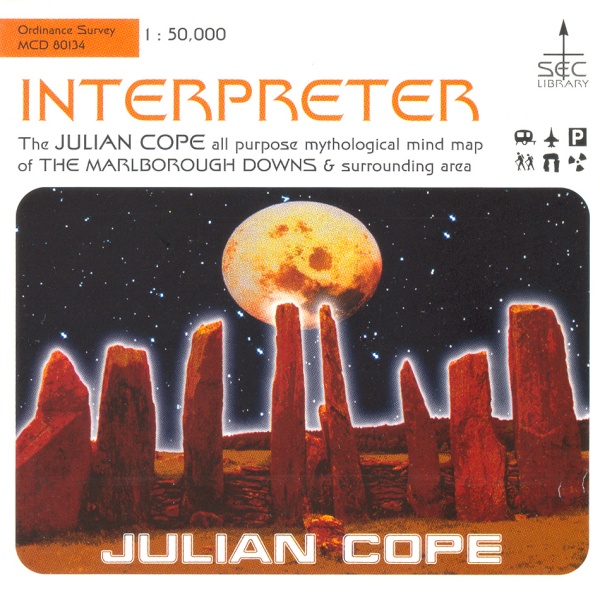
12th studio album (some file it as his 13th and probably include his collaboration album Rite) by Julian Cope is like its predecessor 20 Mothers (Aug. 1995) released on Echo, as his final on another company after which he should only release his music via his own labels. Alledgedly, Cope had rejected to perform in the US, which made Echo cancel their work with Cope. The incident was perhaps the last straw, which made Cope turn his back on the established music industry and from hereon take full control of everything he would do. The album follows more or less the same musical paths as his '95 album, albeit as a stylistically narrower release, where the compositions are Cope's own neo-psychedelic mix of glam rock, beat, folk rock, space rock, and pop. Thematically, it varies between the cosmic, about space travel, and the more down-to-earth stories, but especially strong political positions are noteworthy, which take their starting point from Cope's commitment as an environmental campaigner. There has also been room for his 'Neolithic hobby', although it's only reflected in a poster and the album front cover.
Musically, this appears quite complex with a certain grandiosity, but still with a strict simplicity in the harmonies, as an echo of 70's nostalgia.
The album was not commercially successful, briefly peaking at number #39 on the UK albums chart, and with two singles - tracks #1 and #3 both peaking at number #34 on the singles chart.
Personally, I think there's too much room for distorted guitars, heavy rock attitude, orchestral arrangements, and a repetition of naïve choruses, but still: it's probably part of his fascination of space rock. On the whole, there is a lot of recycling without much originality and at times I find myself wondering if he had either Lou Reed, David Bowie, Tom Verlaine, Scott Walker, or Neil Young on his mind when he wrote and recorded individual tracks. However, it's not only in the somewhat more distant music history that he finds his inspiration. At times he takes completely different paths when incorporating new styles with electronic or a synth-pop touch - and wherever he moves, Cope's strength is to write songs and to speak his mind, even if the messages occasionally drown a little in pompous and odd mixtures of styles. And you really have to give it to him: despite pulling all kinds of stuff from his musical shelves, there's still a remnant of presence and strong universal musical skill at stake - a Copesque charm and completeness, which manages to elevate the album to anything but copycat and mediocrity.
The album was Cope's final on Echo and all of his subsequent music has been self-released either through his own label Head Heritage or through his internet site, carrying the same name, and where he has commented on this and that up until Mar. 2014 when he made his final post. However, he has kept releasing and issuing new albums via Head Heritage since.
Recommended.
[ allmusic.com 4 / 5 stars ]

16 July 2021

Kele "The Waves Pt. 1" (2021)

The Waves Pt. 1
release date: May 28, 2021
format: digital
[album rate: 3 / 5] [3,18]
producer: Kele Okereke
label: Kola Records / !K7 - nationality: England, UK


5th studio album by Kele (aka Kele Okereke, whose full name is Kelechukwu Rowland Okereke) following 2042 (Nov. 2019). Unlike most of his releases, Kele himself is credited as producer on this, as was also the case on his second album out Trick (Oct. 2014).
Unsurprisingly, the album comes with COVID-19 as a theme and as a starting point for the creation of an album, which offers 13 cuts and a total playing length of just under 50 minutes. Nor is it any surprise that Kele presents us with new styles and a mix of all possible inspirations. It's a near natural habit of his that the basic tone of any new album is from a new perspective - much in the same manner as we've come to understand the soundscape in Bloc Party. On this new release, there is less, or practically no room for alt. dance, funk, or disco. Instead, the album is somewhat subdued without approaching a bare folk rock and singer / songwriter orientation, as the one he cultivated on Fatherland (Oct. 2017). It's a type of quiet indie pop and alt. folk with the narrative at the center of the compositions. Where 2042 presented us with a series of tales about future English society, The Waves Pt. 1 are stories about Kele's present time. It's about being a parent, living in a relationship, and it's about small and big changes affecting us all.
Nationally, the album has been met by a somewhat lukewarm reception, but that's not something new for Kele personally, nor for his experiences concerning album releases with Bloc Party.
It's not exactly an album of a lot of ear bangers or melodic hooks, and it's generally a more quiet and introspective Kele as opposed to what you might have expected. It may appear as a demanding album, where the listener must take an active part in an attempt to create his/her own understanding. My first impression had me think of it as an off the target album, but it's not necessarily all bad because it makes demands on the listener. As the title indicates, one could expect The Waves Pt. 2.
Not recommended.
[ The Guardian 2 / 5, NME, Mojo 3 / 5, Clash, Narc Magazine 4 / 5 stars ]

12 July 2021

Captain Beefheart & His Magic Band "Trout Mask Replica" (1982)

Trout Mask Replica
release date: Jun. 16, 1969
format: digital (28 x File, FLAC) (2021 remaster)
[album rate: 3,5 / 5] [3,66]
producer: Frank Zappa
label: Zappa Records / Bizarre Industries - nationality: USA

Track highlights: 1. "Frownland" - 2. "The Dust Blows Forward 'n the Dust Blows Back" - 4. "Ella Guru" - 6. "Moonlight on Vermont" - 7. "Pachuco Cadaver" - 12. "My Human Gets Me Blues" - 14. "Hair Pie: Bake 2" (instr.) - 16. "Well" - 17. "When Big Joan Sets Up" - 18. "Fallin' Ditch" - 21. "Orange Claw Hammer" - 22. "She's Too Much for My Mirror" - 25. "The Blimp (Mousetrapreplica)" - 28. "Veteran's Day Poppy"

3rd studio album by Captain Beefheart & His Magic Band (here: a sextet) follows 8 months after the album Strictly Personal (Oct. 1968). As a start, let's just conclude that this very album is 'beyond'... Just beyond... anything! It's unlike anything else, and for that alone, it's worth paying attention to. Whether you like the content - its musical statement - or not, because it tampers with the idea of music as such. At the point of the release, I guess people thought of it as a band effort and generally thinking of Captain Beefheart & His Magic Band as a unit of sorts - like that of The Jimi Hendrix Experience, and / or Frank Zappa and the Mothers - without comparison but with the idea of a band with a leader, and in this case with Don Van Vliet fronting His Magic Band (sometimes refered to as 'The Magic Band'). And to some extent that perception makes sense; and then on the other hand, when comparing His Magic Band over the years, it appears much more of a one-man project with shifting collaborators - of sorts. Yes, a few of these reappear over many albums but already here, only drummer & percussionist John French plays on all three albums up until this point. Guitarist John Cotton (here credited as 'Antennae Jimmy Semens') was included in the band on the predecessor but this is the first with guitarist Bill Harkleroad (credited as 'Zoot Horn Rollo'), bassist Mark Boston (credited as 'Rockette Morton'), and bass clarinet player Victor Hayden (credited as 'The Mascara Snake') - alledgedly, names that Van Vliet came up with. The album was released as a double vinyl album on Straight Records and with Frank Zappa as sound engineer and producer. Much has been said about this specific album. There are testimonies indicating that much of the recordings were taped live in the studio, or with the band playing instruments in one room and with Don Van Vliet contributing with vocals in another room. And then there's the story of how an untrained Van Vliet composed and made the basics of the songs on a piano (an instrument he didn't know how to play) after which John French transcribed Vliet's instrumental pieces into musical notations that he then handed out to individual instrumentalists to play on their instrument in whatever way the music had been transcribed to fit the specific instrument. Other ideas were used as creative ideas such as having the individual band members sit in isolated rooms playing their part while they couldn't hear the others - same approach was used for recording Vliet's vocal, which resulted in out-of-sync passages that were used as they were recorded, and then there are stories suggesting that Van Vliet insisted on day-long rehearsals which included sleep deprivation and little food intakes to maximize attention to the individual parts - as a way to become a part of the instrument itself.
I first came across this album in the early 80s at the local library. I was immediately attracted by the front cover, which I somehow found appealing. That cover told me what was inside it, was something special. I took the album home and understood absolutely nothing of it and thought of it as unappealing chaotic noise - a mistake. Over the years, I have come across the album at various stages of my life, and each time, I have discovered something new about it, found out that little bit more - and found it increasingly more fascinating. Needless say, the album is longtime a musical treasure and the good old Captain Beefheart has become an icon.
The album wasn't a big contemporary success - hardly any of Captain Beefheart albums experienced major commercial success, although, this one did reach number #21 in the UK. In retrospect however, none of his albums have been rejected as musical failures, which I guess has to do with Van Vliet's mission as an artists: to create music free of conventions [this is not a statement by Van Vliet but my assessment]. There's no doubt that Van Vliet was inspired by early American music and he is nonetheless regarded as one the most genuine original blues rock vocalists. As a composer, he was quite unconventional and an untamed figure. He was always motivated by ideas of creativity and has always found his music labelled as avant-garde. Yes, it's experimental but he appears to have been inspired by free jazz and world music, and what he pursued was perhaps a confrontation of the perception of how music is established as a concept. Why and when do we understand something as music?
Trout Mask Replica is a... wonderous one-of-a-kind release. It's an extensive listen with around 80 mins. playing time. Some regard it as a stunning masterpiece, others see it as more of a non-sensical piece of formative artistic matter. The latter group of people, I find, often reject the album instantly, or quite early. Regardless, how people experience the album, there's no doubt that artists have and will continue to be inspired by its ideas and its output, which in essence comes from an unrestricted form. The album consists of 28 fragments of music - some tracks may sound alike and yet they all give you a taste of patternless music, paradoxically, with obvious traits of patterns. An overwhelming thing about it is that it was produced in 1969 and still sounds as something quite new. And did I mention, it's experimental? Actually, it's quite experimental and could be a bit of overwhelming to listen to in one long take. I'm still in doubt about how to regard it entirely - I guess, I might never will, I'm not a genius but not few have called Van Vliet just that. He may have been living in a period of acid heads but his ideas still made a lot of sense. Just the title of the album is something, isn't?! What is a 'trout mask'? And then a 'replica'! "Ah, the good old 'trout mask' but as a replica! The title itself plays with conception of an idea, of what is art and what sense does it make when we roll a dice and change the rules?
The album is not entirely a pleasant listen, but it surely has its moments. Fragments are there, binding it together for an instant before dissolving and reappearing as something else. Rhythm patterns are not continous. Nothing is. It means, you probably won't be listening to this as a nice background tapestry for any social arrangement. You may not want to put it on while driving with your family, and so on. It's something that require your attention. Pieces and fragments are both funny and absolutely strong. As something with music pleasure potential, I would hand it 1 out of 5 stars. I'm still thinking 4 out 5 and understand critics who see it as 5 / 5 when you see it as a statement that challenges out perception of how music is constructed. And then I land on 3,5 / 5 because of its musical 'qualities'... though, what is quality when speaking of music? And this is the kind of questions you may have to ask yourself when listening to this, which basically proves its worth. I really enjoy it but for various reasons and at various times.
Definitely recommended.
[ 👉allmusic.com, Rolling Stone, Q Magazine 5 / 5, Pitchfork 10 / 10 stars ]

08 July 2021

Julian Cope "20 Mothers" (1995)

20 Mothers
release date: Aug. 28, 1995
format: cd (ECHCD 5)
[album rate: 3,5 / 5] [3,58]
producer: Julian Cope
label: Echo - nationality: England, UK

Track highlights: 1. "Wheelbarrow Man" (live) - 2. "I Wandered Lonely as a Cloud" - 3. "Try Try Try" (Top of the Pops performance) - 4. "Stone Circles 'n' You" - 10. "Adam & Eve Hit the Road" - 15. "Senile Get" - 16. "The Lonely Guy"

11th studio album by Julian Cope is like the one year old predecessor Autogeddon released on the Chrysalis-owned sublabel Echo. With the album, Cope returns to his 'habit' of releasing extensive albums - 20 Mothers is nearly 72 minutes long and is divided into four 'phases', as was also the case with Peggy Suicide (Apr. 1991). His new album is similar to his most recent concept albums without it' being absolutely obvious where the focus lies, because it's more of a unifying album for all of Cope's thematic interests: climate and environment, the condition of our planet, consumerism, cars, religion, prehistoric cultures, and then as a more recent theme of his: stories from one's own lived life about family relationships. In the same way that themes are diverse, the music aspect is even more varied than on most of his other albums. Yes, there is the usual neo-psychedelia and space-rock, and then you'll also find indie rock, funk, and tracks with a clear folk touch, but also elements taken from Europop, synth-pop and rock & roll - in other words, the range is w--i---d----e, and the seemingly conceptual title, supported by the cover featuring family members - wife Dorian and friends, all of whom are actually mothers (as mentioned in the inlay) - then the album basically covers everything, and in that way it comes across as a bit of an all sorts mix - on all levels.
20 Mothers is by no means a bad album, the best side to it being Cope's stories, but at the same time it's somewhat incoherent and occasionally odd to listen to in its entirety.
[ allmusic.com 4,5 / 5 stars ]

 
back cover: 
Julian with his
two daughters

inside:
Julian with family and friends
(wife Dorian on Julian's right)

05 July 2021

Chet Baker "My Funny Valentine [Essential Jazz Masters]" (2006)

My Funny Valentine [Essential Jazz Masters] (compilation)
release date: 2006
format: digital
[album rate: 3 / 5]

Compilation album by Chet Baker, which seems like a reissue but is filed as a 2006 album release, however, all tracks must have been recorded in the 1950s and/or 1960s, which is quite evident from the mono recordings. It features live sessions, hard bop jazz, as well as his romantic cool jazz ballads including one vocal jazz track, which sort of comprises all his styles but also makes it a very uneven compilation of songs.

03 July 2021

Marie Key "Marie Key" (2020)

Marie Key
release date: Oct. 23, 2020
format: digital (11 x File, FLAC)
[album rate: 3,5 / 5] [3,72]
producer: Andreas Sommer
label: Temper Records - nationality: Demark


5th studio album by Marie Key following a little more than two years after Giganter (Jul. 2018) sees a welcome back to producer Andreas 'Maskinen' Sommer, who is credited as multi-instrumentalist and also as co-composer of six out of a total of eleven songs. The album also sees a few featuring guests, which include Tim Christensen on guitar (track #2), Christoffer Gregersen on vocals (track #6), and Simon Kvamm on vocals (track #9). The album has primarily been issued as a vinyl only album (also available as digital download) but not in cd format, and it appears to be the first release on Key's own label, Temper Records.
As many releases from 2020 the album has been recorded and produced at a time of uncertainty - with reference to global lockdowns and in that regard it may have been delayed as Key probably were prevented to follow it up with a tour.
Marie Key is a way of showing a more stripped down view on an artist, who has taken the country by storm but also experienced a difficult time after two acclaimed albums, although Giganter was a fine album, it just wasn't welcomed by enthusism nor great reviews. And that tendency may have hit this very album even harder as it hasn't been promoted with much fuss and then it basically appears to have near vanished from any public interest, which is more than really strange. Yes, the song "True Love" was a minor national hit but the album failed to enter top 40 and seems to have come out only to be greatly ignored, which is quite sad because it's a fine album on which Key once more showcases her position as a gifted contemporary songwriter of personal and inner conflicts with an obvious broad appeal and always serving her songs with glimpses of hope, despair, and humour, but also has a purposeful sense for a wider target group. It's both simple narratives and modern poetry on a another level than generic pop without substance. Key simple deserves more listeners but may have found the limitations in singing entirely in Danish when everyone's eyes and ears are on a globalised perfect world that is reflected to us via Insta, Tik-Tok, X - the SoMe-poison.
Definitely recommended.
[ Gaffa.dk, Kulturen.nu 4 / 6, 💩Ekstra Bladet 3 / 6 stars ]

26 June 2021

Paul Weller "Fat Pop (Volume 1)" (2021)

Fat Pop (Volume 1)
udgivet: 14. maj 2021
format: digital
[vurdering: 4 / 5] [3,76]
producer: Paul Weller & Jan 'Stan' Kybert
selskab: Polydor Records - nationalitet: England, UK


16. studiealbum fra Paul Weller udkommer blot 10 måneder efter det glimrende On Sunset (jul. 2020), og igen er det en udgivelse med producer og multi-instrumentalist Jan Kybert. Han arbejdede første gang sammen med Weller på albummet Studio 150 i 2004 og har siden medvirket på de fleste af Weller's studiealbums, enten som musiker eller som medproducer.
Albummet følger fint det musikalske udtryk, man finder på 2020-albummet, uden blot at være en gentagelse. Det virker snarere som om, Weller på sine ældre dage har fundet frem til sit helt eget udtryk med lån fra alle mulige genrer og stilarter, men som ikke desto mindre lyder umiskendeligt som Paul Weller og ingen andre. Det er britisk soul med stærke rødder i 60'ernes gyldne beatmusik, krydret med mod, traditionel amerikansk r&b og lige dele moderne stilarter, der får ham til at lyde som en slags enmands-Gorillaz. Andre gange fornemmer man noget sært velkendt, som på den både smukke og dybfølte "In Better Times", hvor stemningen i sig selv vækker levende mindelser om fine ballader fra The Jam, The Style Council eller fra Weller's tidlige soloudgivelser - og så alligevel fremstår nummeret nyt og personligt.
Endnu en gang placerer Weller sig blandt de ypperste engelske sangskrivere uden at lyde gammeldags eller ude af trit med nutiden.
Anbefalet.
[ allmusic.com, NME 4 / 5, Clash, American Songwriter, musicOMH 3,5 / 5 stjerner ]

19 June 2021

Mark Kozelek "Mark Kozelek" (2018)

Mark Kozelek
release date: May 11, 2018
format: 2 cd
[album rate: 3,5 / 5] [3,62]
producer: Mark Kozelek
label: Caldo Verde - nationality: USA

Track highlights: Disc 1) 1. "This Is My Town" - 2. "Live in Chicago - 3. "The Mark Kozelek Museum" - 4. "My Love for You Is Undying" - 5. "Weed Wacker" - 6. "Sublime"
Disc 2) 1. "Good Nostalgia" - 2. "666 Post" - 5. "I Cried During Wall Street"

Solo album by Mark Kozelek following the ep Night Talks (Mar. 2017) but this is only when counting pure Kozelek releases 'cause in between these two, Kozelek has issued two collaboration albums: Yellow Kitchen (Jun. 2017) together with Sean Yeaton (bassist in noise folk band Parquet Courts) and Mark Kozelek with Ben Boye and Jim White (Oct. 2017) - Boye has performed on several albums by Kozelek (often when performing as Sun Kil Moon) and Australian drummer Jim White (who has a long history as sessions musicians for e.g. Cat Power, Nick Cave, PJ Harvey, and Martha Wainwright), White also plays drums on the Yellow Kitchen album. This album consists of 11 tracks. It comes as an 11 track digital album, a 2 CD issue, and as a 2 lp vinyl issue, all with a total running length of more than 88 minutes.
Kozelek continues his flow of releases, which has been an ongoing production in the fast lane for most of a decade. He has issued an abundance of releases either using his birthname, his moniker Sun Kil Moon, or he has been engaged in various collaboration projects with a long list of others with different musical background. The common denominator is, however, Kozelek's songwriting - it's primarily long compositions, varying in length from typically 4 to 15 mins and characterised by drone-like or progressive backing, which at times, and especially when referring to his latest works, are pure improvs. Also his lyrics. Kozelek has taken a move away from written material to compositions which are pure streams of consciousness. A negative response to this labels some of his albums as 'babbling', and then others appreciate his original style. The thing is, when listening attentively to his narrations, there are always funny aspects and if you accept the style and forget that lyrics should be sung - Kozelek often just rambles along like reading aloud from diary notes mixed with journals or news paper articles, and he always takes a starting point in experienced episodes - but this may take him far. He returns to certain preferred subjects, which include boxing, music, drinking, authors, films and actors, and then he also talks explicitly about sex. A constant are his everday life experiences of ordinary things like shopping, meeting people in the street, discusssions with someone about life or death or just about who's right and who's wrong, and then: descriptions of the road, the apartment, where he finds himself at, seing cats or dogs, about forgetting, about remembering something important / not really important, about what he thinks of this or that song, this or that album, this or that artist. It's like listening to someone talking about everything and nothing. But. That can be a fascinating journey, and that's what I have come to enjoy about Kozelek: he's basically a great narrator.
It has taken me quite some time to get accustomed to Kozelek's change of style going from what some labeled 'slowcore' onto a more distinct alt. folk scene with bonds to americana and indie folk and / or indie rock to this modern expression of his, which at first could sound like he's not really making any efforts anymore. But I mostly just enjoy his sometimes hilarious observations, and I have come to see it more in line with other types of artistic advancement. Think of the progression of style by Picasso - imagine the sublime painter, who was fully capable of producing natural / photo-like and detailed sceneries, and then he went through stages with surrealism, developing cubism and a freer form of new-cubism - fra from his starting point. Now, Kozelek is not a contemporary Picasso, and the comparison may seem ridiculous, but Kozelek too has gone his own ways in forming a new musical style based on improvs in a scenery of spoken-word arrangements. Like it or not, but this is his prefered expression at this point in a long career.
Recommended.
[ allmusic.com 3,5 / 5, Pitchfork 6,8 / 10, TheNeedleDrop 7 / 10, SputnikMusic 3,6 / 5 stars ]

12 June 2021

Robert Forster "Songs to Play" (2015)

Songs to Play
release date: Sep. 18, 2015
format: digital (10 x File, FLAC)
[album rate: 3,5 / 5] [3,58]
producer: Robert Forster, Luke McDonald & Scott Bromiley
label: Tapete Records - nationality: Australia

Track highlights: 2. "Let Me Imagine You" - 4. "And I Knew" - 6. "I'm so Happy for You" - 8. "Turn on the Rain" - 9. "I Love Myself and I Always Have" - 10. "Disaster in Motion"

6th studio album by Robert Forster following a full 7½ years after The Evangelist (Apr. 2008). Apparently, most of these songs were written in 2010 / 2011 but weren't recorded until around five years later. Forster has explained that he needed a break in his music career, and initially had set himself up for a five-year hiatus, which then turned into seven... It was a period during which he wrote music articles and simultaneously worked on his autobiography. The album has been made completely without former collaborators Adele Pickvance and Glenn Thompson. Forster clearly wanted to make a fresh restart and in their place he has invited the two members from Australian The John Steel Singers: Luke McDonald and Scott Bromiley - both as multi-instrumentalists. Forster produced the band's 2010 debut Tangalooma and together they then played some of these songs, which would end up on Songs to Play, and here the two are also credited as co-producers. Forster's wife, Karin Baümler, previously participated on his albums playing violin and doing backing vocals, but on this, she has played a fuller part on all tracks, and together with drummer Matt Piele from Forster's tour band, they all form the new backing 'band', which of course gives the output new colours.
Although McDonald and Bromiley have been given rein to contribute with their ideas, it's still very much a Robert Forster solo with lyrics and music credited the man himself. The style is laid in an acoustic contemporary folk rock characterised by strong bonds to classic rock & roll in its simplest form. At times it's uptempo without being danceable rock and the songs appear with a marked lightness compared to the gloomier tone on his previous albums.
Songs to Play is an album where the music has come to the fore and Forster successfully acts as a classic singer / songwriter without being weighed down by his former achievements, suppressed emotions and the melancholy, which have been natural traits in the past, and by that, the album could pave the way for a new dynamic in his original musical realm. In any case, it's not an album, as the predecessor, that sounds like falling in between The Go-Betweens and a solo album - it's definitely a pure Robert Forster release on which he deals with the present.
The front cover is a photo of Robert and Karin's daughter Loretta Forster.
Recommended.
[ allmusic.com, PopMatters 3,5 / 5, The Guardian 4 / 5 stars ]

11 June 2021

Kraftwerk "The Mix" (1991)

2009 remaster
The Mix
release date: Jun. 11, 1991
format: cd (2009 remaster)
[album rate: 3,5 / 5] [3,38]
producer: Ralf Hütter, Florian Schneider
label: Kling Klang / EMI - nationality: Germany

10th studio album by Kraftwerk following a full five years after Electric Cafe (1986) isn't officially a compilation, although it may perfectly appear as that since it's dedicated to compositions stemming from all of the band's studio albums beginning with Autobahn (1974) right up to the most recent studio album Electric Cafe (1986). Ralf Hütter has offered his thoughts on why it's not to be considered a compilation or let alone a remix album, as others would claim. He states that these tracks are an expression of the band's live versions of well-known songs, all of which have been subjected to reshaping during the many years of performances. Since '86 percussionist Wolfgang Flür has left the band and as of '87, he was practically substituted by Fritz Hilpert. In 1990, Karl Bartos also left the band, after which Fernando Abrantes took over in his place and on the album here, but Abrantes left shortly after the release only to be replaced by Henning Schmitz.
Incidentally, 2009 is the year in which Kraftwerk reissued all of the it's essential albums in newly remastered editions - like this one - and they also reissued the box set Der Katalog (2004) with a back cover label '12345678', indicating the band's 8 studio albums from 1974 to 2003. Regardless Hütter's explanation, and intention, it doesn't change the fact that the tracks on The Mix have all been taken from previously released studio albums, and yes, they are here in completely new remixed versions. The album consists of 11 tracks and has a total running length of 65 minutes.
From both Autobahn (1974) and Radio-Aktivität (1975) only the respective title tracks have been included; from Trans Europa Express (1977) three tracks are included: the title track, "Abzug" and "Metall auf Metall"; from the album Die Mensch-Maschine (1979) only "Die Roboter" has found its way the this; from Computerwelt (1981) we again find three selected tracks: "Taschenrechner", "Computer Liebe", and "Heimcomputer", and from Electric Cafe (1986) only the song "Music Non-Stop" is included. With a bit of quick math, that sums up to only ten tracks, and that's because, in addition to album tracks, there's also room for "Dentaku", which is a Japanese version of "Taschenregner" in a slightly different version, originally featured as a B-side to the single release.
The album received a slightly luke-warm reception, but still landed at number #7 in Germany and at number #15 in the UK. Kraftwerk also released the new versions of "Die Roboter" and "Radio-Aktivität" as the two (promotional) singles from the album.
The Mix is a fine album without dazzling. However, I think that especially the earliest compositions have been altered and given a more modern sound in such a way that they certainly don't stand as improvements to the originals. Later well-known tracks have been exposed to a little bit of everything, and at the end, the album is mostly for fans and connoisseurs, as others will be better served with the original versions. And of course you're are free to think what you want about all their fine tracks they have passed on and not included here. You may ask yourself why on Earth they didn't just release a double album, when there's plenty of material to revisit? It's certainly not an essential release, which basically functions more as bonus material - an appendix you can easily do without.
[ allmusic,com, Mojo 3 / 5, Q Magazine, Uncut 4 / 5 stars ]


org. cover

07 June 2021

Cassandra Jenkins "Play Till You Win" (2017)

Play Till You Win [debut]
release date: Apr. 7, 2017
format: digital (11 x File, FLAC)
[album rate: 3,5 / 5] [3,42]
producer: Cassandra Jenkins & Sam Owens
label: self-released - nationality: USA

Track highlights: 1. "Candy Crane" (live) - 2. "Tennessee Waltz" - 5. "Red Lips" - 6. "Disappearing" - 9. "Disco Death Dance" - 10. "Some Time" - 11. "Halley" (live)

Full-length studio album debut by Cassandra Jenkins is a decent first-attempt where she already upholds a certain self-reliance as someone who's been around much longer. And that is something, which is stressed by how the album is both a coherent and nicely varied experience. She has her own laid-back singing style and maturely builds on classic folk rock and country of the 70s without sounding dated. What lacks, are stronger personal songs and some of the original quality you'll find on her later releases, but all in all, Play Till You Win is a fine debut.
[ The Line of Best Fit 7,5 / 10 stars ]

28 May 2021

Nick Cave & Warren Ellis "Carnage" (2021)

Carnage
release date: Feb. 25, 2021
format: digital (8 x File, MP3)
[album rate: 3,5 / 5] [3,68]
producer: Nick Cave & Warren Ellis
label: Goliath Records - nationality: Australia


First actual duo-project credited Nick Cave and Warren Ellis, long time collaborators in Nick Cave & The Bad Seeds, who most recently released Ghosteen in 2019. However, since 2005 when they made music for the performance "Woyzech", they have co-written music for a large number of performances and films - which are also available as soundtrack releases. Ellis has been a member of The Bad Seeds since the '97 album The Boatman's Call, but has featured on the band's albums since '92, and his role in the band has only grown over time. In '97 he had a minor part playing violin and keyboards as 'extra spice' to the band's sound, from the 2001 album No More Shall We Part he was also credited some compositions, from the 2008 album Dig, Lazarus, Dig!!! he is a distinctive composer and multi-instrumentalist, and from Push the Sky Away in 2013 he is now credited as composer along with Cave on all tracks, and thus the musical center of the band has shifted to being exclusively a pair collaboration in recent years, with Cave providing lyrics and Ellis supplementing with music. Therefore, the album here is not a huge surprise, since this is how they have worked on their recent three studio albums. The music with The Bad Seeds has thus transformed over the years from being alt. rock towards an increased focus on Cave's lyrics to being a kind of poetic recitations with evocative background music.
On Push the Sky Away you'll notice percussion, bass, and guitar, but it's with instrumentation such as violin, cello, and keyboards as the main sound sources, and there's a stylistic interference with elements from jazz, Tindersticks, and something reminiscent of Tom Waits' experimental style. This new and more naked soundscape becomes even more evident on Skeleton Tree, and with Ghosteen the rhythmic element is now completely absent, replaced by Cave's insistent vocal and Ellis's keyboards as spheric tapestry.
On Carnage you'll find a progression towards more complex compositions, where guitar, bass, and percussion are occasionally heard - mostly on "Old Time". In that way it sounds more like the continuation of Skeleton Tree rather than Ghosteen, but most of all it's a new chapter in the book of human pain, sorrow, and suffering as experienced by Nick Cave. From being a direct dramatic writer who told about crooked existences and people living in the shadows of society, Cave has grown over the past decade into a more lyrical playwright who talks about existential aspects of life and death.
The album has been met by positive reviews - but that's nearly always how it works for Cave. He is, if anything, a critics' darling, and the album has landed several international top-10 positions, including number #2 in Australia, number #3 in the UK, Belgium and in the Netherlands, number #5 in Germany, and a number #1 position in Scotland and Portugal.
It's a nice and fine acquaintance without fillers but perhaps also the slightly expected release. However, the music is good, the lyrics compelling and the level high. It's an album that wins over time because Cave and Ellis are just great together.
Recommended.
[ allmusic.com, Pitchfork, Rolling Stone 4 / 5, Gaffa.dk 5 / 6, NME 5 / 5 stars ]

18 May 2021

John Travolta / Olivia Newton-John "You're the One That I Want" (1978) (single)

You're the One That I Want
, 7'' single
release date: Mar. 1978
format: vinyl
[single rate: 3,5 / 5] [3,38]
producer: John Farrar
label: RSO - nationality: Australia / USA


Single release taken from the 1978 musical film "Grease" by Randal Kleiser. I think I may have purchased this particular item myself at the age of 14, probably after watching the film. I can't say that I was a fan of neither Newton-John nor of Travolta, but I do recall liking the film and the energy of the title track.


~ ~ ~
This post is part of MyMusicJourney, which enlists key releases that have shaped my musical taste when growing up and until age 14. Most of these releases come from my parents' and / or my older brother's collection.

12 May 2021

Toyah "Minx" (1985)

Minx
release date: Jul. 25, 1985
format: digital
[album rate: 2,5 / 5] [2,72]
producer: Christopher Neil
label: Portrait Records - nationality: England, UK

Track highlights: 1. "Soldier of Fortune, Terrorist of Love" - 2. "Don't Fall in Love (I Said)" - 3. "Soul Passing Through Soul" - 11. "America for Beginners"

Studio solo debut by Toyah Wilcox, although it's also the sixth album credited Toyah. After Love Is the Law (Oct. 1983) the band faced declining sales figures and interest, and most of the band members became engaged in other acts, basically, leaving Wilcox and Joel Bogen alone - once again. Except this time, Toyah Wilcox now signed a contract with CBS subsidiary Portrait as a solo artist. Songwriting duo Wilcox / Bogen is here credited a single song (track #7), while most of the other tracks are credited Wilcox and keyboardist Simon Darlow. The album also feature a total of four covers - songs originally released by Rare Bird (track #4), DATA (track #6), Alice Cooper (track #9), and Latin Quarter (track #11).
Alledgedly, the money men of the label had much to say in terms of details about the sound and style of the album, and also regarding what specific tracks they wanted on an album that appears to have been produced with an American market in mind, i.e. with clear focus on a mainstream style within a pop / rock bubble at a time when synthpop and the contemporary soft version of new wave with toned-down art pop was state-of-the-art. The arrangements show bold use of vocal harmonies, keyboards, and the typical '80s drum sound, as well as the use of strings. Even the front cover highlights a shift towards a different audience in mind with a Toyah Wilcox [in a Sheena Easton / Frida / Tina Turner look-a-like] style and definitely not meant for punk rock associations.
The album actually performed quite well, peaking at number #24 on the national albums chart, and the first single "Don't Fall in Love (I Said)" peaked as number #22. Tracks #3 and #10 were also issued as singles and landed as No. #57 and #93, respectively.
Both musically and stylistically, Toyah simply ceased to appeal to me after Love Is the Law, and this very album just cemented my lack of interest. I believe much of the relatively significant commercial success that she faced after all is largely due to her background as an actor in a number of British films, TV series, and in roles as TV presenter on various BBC-productions. From a musical historical perspective, the band Toyah and soloist Toyah Wilcox released only a few really substantial albums, where Anthem (1981) is the only truly outstanding original.
One year following Minx, Wilcox married guitarist Robert Fripp, and she continued to release solo albums up until '96, after which the pace of new releases slowed considerably. The 2008 album In the Court of the Crimson Queen - paying tribute to husband Fripp's band King Crimson's acclaimed debut In the Court of the Crimson King from 1969 - from the beginning of 2021, is Wilcox's most recent studio album.
Not recommended.

04 May 2021

Kings of Leon "When You See Yourself" (2021)

When You See Yourself

release date: Mar. 5, 2021
format: digital
[album rate: 4 / 5] [3,80]
producer: Markus Dravs
label: RCA Records - nationality: USA


8th studio album from Kings of Leon following 4½ år after WALLS (Oct. 2016) is the band's second consecutive album to be made with producer Markus Dravs.
Stylewise, this new album doesn't come up with great many surprises. Kings of Leon is a band set on playing their own melodic mix of alt. rock and they basically keep quite strict to a formula they have distilled on since 2008 / 2010. And yet, this one comfortly manages to place itself in the better half of the band's repertoire, thus distancing itself elegantly from the poppier WALLS, which still holds up the band's so far only to reach the glorious national first spot on Billboard 200. Saleswise, it would have been expected that the band and its record company in support would go for a replication of success, but instead the band has produced, what to me sounds like, a gracious mix of its artistic peak with Come Around Sundown (2010) and Only by the Night (2008). By doing so, you could argue that Kings of Leon have found back on a proper course they sought out a decade ago but which instead took them on a sidetrack occupied by pop-ballads - something you'll find plenty of on their previous two studio albums from 2013 and 2016, respectively. Even with some retreatment to former heydays, When You See Yourself still makes a fine updated version of one of the finest US rock bands this century.
Highly recommended
[ allmusic.com, Clash 3,5 / 5, 👍NME 4 / 5 stars ]

03 May 2021

Les Negresses Vertes "Famille nombreuse" (1991)

Famille nombreuse

release date: Nov. 1, 1991
format: vinyl (gatefold) / digital
[album rate: 3,5 / 5] [3,68]
producer: Sodi & Clive (aka Clive Martin)
label: Delabel / Razzia Disques - nationality: France

Track highlights: 1. "Famille heureuse" - 2. "Perpétuellement vôtre" - 6. "Sous le soleil de Bodega" - 8. "Hou ! Mamma mia..." - 9. "Infidèle cervelle" - 10. "La France a ses dimanches" - 12. "Car c'est un blouze"

2nd studio album by French band Les Negresses Vertes, which here enlists eleven members, although the cover photos only counts ten members. Prior to this, the band featured on the international Cole Porter tribute album Red Hot + Blue from 1990 with their version of "I Love Paris".
Here, the band attempts to continue in the same style from Mlah (1989), but nevertheless with more polished arrangements, which lacks the rebellious streak that caused the band to be compared to Madness and The Pogues. However, the album does succeed in presenting a more common tone, where Mlah pointed in various directions and also reflected music from a sea of ​​styles, and in that regard Familie nombreuse is an album that roughly stays on the same ground throughout. It's original, but in my mind it's missing that extra kick the debut contained. Having said that, the music here is by no means poor, but at times sticks out as slightly uninspired, although I personally find that the album actually improves in the latter half - perhaps simply because these songs share some of the traits from Mlah.
Familie nombreuse [meaning 'large family'] is the band's final with the its front figure, lead vocalist, and one of its major songwriters: Helno Rota, who died of an overdose in '93 (at the age of 29), after which the band's line-up changed considerably. The band continued to release albums up until around 2001, after which they have been less active. However, around 2018 and up to the 30th anniversary of this very album, Les Negresses Vertes (reformed with several of the original members) resumed their live performances, playing tracks from Mlah in particular (see here and here - and here a promotion spot for their tour).
[ 👎allmusic.com 2 / 5 stars, Popdose review ]

01 May 2021

Elvis Costello "The Best of Elvis Costello - The First 10 Years" (2007)

The Best of Elvis Costello - The First 10 Years
(compilation)
release date: May 1, 2007
format: digital
[album rate: 4,5 / 5]
producer: various
label: Hip-O Records - nationality: England, UK

Best of compilation by Elvis Costello compiled by Costello himself is a strong contender to the best single disc compilation around with his earliest - and best - material. The selection starts off from the debut album My Aim Is True (1977) and ends with his last album released on F-Beat, Blood & Chocolate (1986). A couple of fine things about the album is how all studio releases except (the shallow) Goodbye Cruel World (1984) from this ten year period are represented, and that the songs appear in chronological order. The total of 22 tracks is made up from three taken from Costello's first three albums, My Aim..., This Year's Model (1978) and Armed Forces (1979), then two from albums 4 and 5, Get Happy!! (1980) and Trust (1981), one composition from his 6th, Almost Blue (1981), then again three from his 7th, Imperial Bedroom (1982), two from his 8th, Punch the Clock (1983), two from his 10th, King of America (1986), and one song from his 11th, Blood & Chocolate. Of course there's no way he would be able to satisfy everyone's taste and personally; I miss more from Get Happy!! and Blood & Chocolate and I could live without few of the selected, but ultimately, it's impossible to pick 22 tracks only, and when going for 1-3 songs from these albums, it's a pretty decent job.
[ allmusic.com 4,5 / 5 stars ]

24 April 2021

Les Negresses Vertes "Mlah" (1989)

Mlah [debut]
release date: (Jan.?) 1989
format: vinyl / cd (1991)
[album rate: 4 / 5] [3,92]
producer: Clive Martin, Sodi (aka Sodi Marciszewer)
label: Delabel - nationality: France


Studio album debut by French 8-piece orchestra Les Negresses Vertes ['The Green Negresses', or: 'The Green Black Girls'] consisting of lead vocalist Helno (aka Noël Rota, aka Helno Rota de Lourcqua), guitarist and backing vocalist Melino (aka Stéfane Michel Mellino), accordion player and guitarist Mathieu Canavese (aka Mathieu Crespin), bassist Paulo (aka Jean-Marie Dominique Paulus), harmonica player and trombonist Abraham Sirinix, trumpeter and percussionist Twist (aka Michel Ochowiak), pianist and percussionist L'Ami Ro (aka Joël Ruffier Des Aimes), and drummer Gaby le Magnifique (aka Laurent Gabriel). The band formed in the Autumn of '87 in Paris and has roots in the South of France and with many other national ties - e.g. to Algeria, Poland, Italy, and Spain. The album was originally released on French Off The Tracks Records and Razzia Disques, while international editions were released on several labels including Virgin, Sire, Polydor, and Warner Bros.
Stylistically, Mlah represents a huge mix of styles but is primarily bound to French musical traditions. There are obvious parts of folk rock and punk rock, which in places point in the direction of French Mano Negra, and / or British The Pogues, and then elsewhere more in the direction of Madness in a French version of ska. You'll also notice a strong influence from traditional music such as 'gypsy music', flamenco, muzette, and waltz, and the band's music has thus been referred to as 'gypsy punk' - although that designation is far from sufficient. Some have called Les Negresses Vertes a 'global-folk-punk-band', although that only serves to prove it more than ordinarily difficult to categorise the band's style.
I purchased the album back in '89 - and actually played it quite a bit, but unfortunately, I lost the vinyl version along the way. However, I have since got hold of a cd reissue containing two bonus tracks, and a copy of the same vinyl issue I once owned. The original version comes with 12 tracks and a total running length of approx. 42 minutes, while the '91 cd issue is approx. 48 minutes.
Mlah is the band's first, and in my view also their absolute best. There's an immediateness and a joy of playing, and the album mostly sounds like what it is: recorded live in a studio with all members in high spirits, which is aptly conveyed in the official music video for perhaps the their best-known song: "Zobi la Mouche" -  also listen to "Voilà l'été".
Highly recommended.
[ 👍allmusic.com 4 / 5 stars ]

19 April 2021

Tindersticks "Distractions" (2021)

Distractions

udgivet: 19. feb. 2021
format: vinyl (LTD. blue vinyl) / digital (7 x File, FLAC)
[vurdering: 4 / 5] [4,02]
producer: Stuart A. Staples
selskab: Lucky Dog / City Slang - nationalitet: England, UK

Fuld trackliste: 1. "Man Alone (Can't Stop the Fadin')" - 2. "I Imagine You" - 3. "A Man Needs a Maid" - 4. "Lady with the Braid" - 5. "You'll Have to Scream Louder" - 6. "Tue-Moi" - 7. "The Bough Bends"

13. studiealbum fra Tindersticks efterfølger No Treasure but Hope (nov. 2019) og er udgivet på Stuart Staples' eget label, Lucky Dog, med hjælp fra det uafhængige tyske selskab City Slang. Bandet er stadig samme kvintet, bestående af forsanger, primær sangskriver og komponist Stuart A. Staples, guitarist Neil Fraser, basist og tangentspiller Dan McKinna, tangentspiller David Boulter og trommeslager Earl Harvin. Albummet indeholder blot syv numre og har en samlet spilletid på lige over 46 minutter, hvilket betyder, at flere numre har længere spilletid end de sædvanlige 3 til 4 minutter - selvom bandet på de seneste udgivelser har forsøgt sig med andre utraditionelle tiltag i udviklingen af bandets lydunivers. Lidt ukonventionelt starter albummet her med det absolut længste nummer, der varer mere end 11 minutter, og nummeret er da også usædvanligt for Tindersticks, da det har en tydelig elektronisk kant. Herefter fortsætter albummet mere traditionelt for bandet med ret simpelt opbygget chamber pop uden en masse dikedarer udover Staples' markante vokal oven på stille guitartoner, et næsten ikke-eksisterende ambient keyboard og svagt-hørbare strygere - og helt uden traditionelle trommer. Et andet nyt træk er tilstedeværelsen af covers. Ud af albummets syv numre er der tre coversange, og selvom originalversionerne er ret tilgængelige, har Tindersticks forvandlet disse til rene Tindersticks-sange, så det hele fungerer ret fint sammen. "A Man Needs a Maid" er en velkendt Neil Young-sang fra hans klassiske Harvest-album fra 1972, og den er her fuldstændig tilpasset et Tindersticks-univers med lyse korstemmer og Staples' kontrasterende mørkere vokal - resultatet er rigtig godt. Det efterfølgende nummer, "Lady with the Braid", er sandsynligvis en mindre kendt sang for de fleste, skrevet af [Dorothy] Dory Previn [aka Dory Langdon, aka Dory Previn Shannon] og hentet fra hendes andet singer / songwriter-studiealbum Mythical Kings and Iguanas fra 1971. Denne efterfølges af det sidste covernummer: "You'll Have to Scream Louder" skrevet af Dan Treacy til det britiske post-punk band Television Personalities og hentet fra 1984-albummet The Painted Word. Herefter fortsætter Distractions med en ligeledes næsten typisk Tindersticks-komposition med fransk tekst: "Tue-moi" ['Slå mig ihjel'], hvor Staples med sit engelsk-franske [beklager] gør sit bedste i fransk 'chanson'-stil, hvilket nok kun briter og visse smigrede franskmænd vil opfatte som noget ekstraordinært. Sangen er dog noget helt særligt på en anden måde, da det er Staples' inspiration fra og hans tanker om attentatet på det franske spillested Bataclan i 2015 - et spillested, som Tindersticks har besøgt flere gange. Albummet slutter lidt, som det starter - med et lidt mere eksperimenterende nummer med tape-loops og 'anden elektronik', selvom det stadig mest bare lyder som Tindersticks i det lidt jazzede hjørne. På sin vis minder albummet om Staples' seneste soloudspil, albummet Arrhythmia fra 2018, som er første gang, man bemærker Staples eksperimentere med elektroniske virkemidler. Dét album var også usædvanligt på grund af sine ret lange kompositioner.
Alt i alt, er Distractions et album, der byder på både nyt og gammelt, og som umiskendeligt er Tindersticks, der for alvor har skruet ned for arrangementerne, men det er et album, der vinder over tid. Det velkendte chamber pop-element er kun svagt til stede, mens der i stedet er blevet plads til noget eksperimenterende, der låner fra både moderne stilarter og fra jazz.
Tindersticks fortsætter med at lave fascinerende musik - det virker som om, de har fundet deres helt egen plads i alt. rock-sfæren med plads nok til at fortsætte eksperimenterne uden samtidig at miste den kunstneriske fremdrift. Og jeg er fristet til at spørge: "Hvornår har det her band egentlig lavet et dårligt album?" Det er i hvert fald meget længe siden, og det har bestemt ikke været tilfældet, siden bandet var ramt af interne konflikter omkring årtusindskiftet.
Stor annbefaling.
Coveret til albummet er krediteret Sidonie Osborne Staples - datter til Stuart Staples & Suzanne Osborne.
[ 👍allmusic.com, Uncut 4 / 5, musicOMH 4,5 / 5 stjerner ]

15 April 2021

Band of Horses "Mirage Rock" (2012)

Mirage Rock
release date: Sep. 18, 2012
format: digital (11 x File, FLAC)
[album rate: 3 / 5] [3,12]
producer: Glyn Johns
label: Columbia - nationality: USA


4th studio album by Band of Horses follows 2½ years after Infinite Arms and it introduces Glyn Johns as producer. For once, the line-up remains unchanged from the previous album.
Initially, the album was met by quite positive reviews with critics stating that the band continues to deliver a remarkable strain of folk rock, but after some time the overall reception seemed to be less overwhelming with fans seing this a step down. The band gained some succes with the promotion single "Knock Knock" but both that and the two following singles (tracks 3 and 9) failed in the charts and the album didn't perform like the predecessor.
In my mind, the band performs fine, Bridwell sings with enthusiasm, and overall the album appears as nice and warm, but it also has a tone of something anonymous. The biggest lack is its coherency with some tracks appearing as mere fillers. A few tracks are truly fine and stand out as solid workmanship, but compared to the first two albums, this is goes down as a pale immitation.
[ allmusic.com, Rolling Stone 3,5 / 5, Q Magazine 3 / 5, Pitchfork 4,0 / 10, Spin 2 / 5 stars ]