Showing posts with label psychedelic rock. Show all posts

23 January 2025

The Dukes of Stratosphear "25 O'Clock" (1985)

25 O'Clock
udgivet: 1. apr. 1985
format: cd (2009 remaster - APECD023)
[vurdering: 3,5 / 5] [3,52]
producer: John Leckie, Swami Anand Nagara, The Dukes
selskab: Ape House - nationalitet: England, UK

Udvalgte numre: 1. "25 O'Clock" - 2. "Bike Ride to the Moon" - 3. "My Love Explodes" - 4. "What in the World??…" - 5. "Your Gold Dress" - 6. "The Mole From the Ministry" - 13 "Black Jewelled Serpent of Sound (Radio Caroline Edit)" - 14. "Open a Can of Human Beans" - 15. "Tin Toy Clockwork Train"

Debutalbum fra projektbandet The Dukes of Stratosphear - i bund og grund XTC, der her hygger sig med at spille psykedelisk rock, som det lød fra midten til slutningen af 1960'erne. Det originale album udgivet på Virgin Records er et mini-album på seks numre og en samlet spilletid på under 27 minutter, mens 2009-remaster udgaven (udgivet på Andy Partridge's selskab Ape House) tilføjer yderligere ni numre bestående af demo-optagelser og outtakes, hvilket forlænger spilletiden til 49 minutter. På tidspunktet for udgivelsen var XTC en trio bestående af vokalist & guitarist Andy Partridge, vokalist & guitarist Colin Moulding samt lead-guitarist & tangentspiller Dave Gregory, og med inddragelsen af Daves bror Ian på trommer optræder de her som The Dukes, fordi sidstnævnte ikke var en del af XTC. På albummet er de alle krediteret under navnene Sir John Johns, The Red Curtain, Lord Cornelius Plum og E.I.E.I. Owen [!]. Producer John Leckie er krediteret med både sit rigtige navn og sit alias: Swami Anand Nagara.
Stilmæssigt er det et stærkt forsøg på at producere musik med Syd Barrett-udgaven af Pink Floyd i tankerne. Angiveligt blev alt spillet og indspillet på gammelt udstyr [wiki om albummet].
Gennem det meste af karrieren som XTC, har bandet inddraget elementer fra psykedelisk rock - på senere albums bliver XTC mere direkte eksponent for neo-psykedelisk rock, og det er tydeligt, hvordan dette sideprojekt kan ses i XTC's stilmæssige udvikling - især med tanke på trækkene fra de efterfølgende albums, fx: Skylarking (1986), Oranges & Lemons (1989), Nonsuch (1992) og Apple Venus Volume 1 (1998).
Albummet blev promoveret af Virgin som en slags egentlig debut - som en samling 1960'er-kompositioner af et hidtil ukendt band, der endelig ser dagens lys og får sin udgivelse. Mest sigende er det, at albummet solgte dobbelt så mange eksemplarer som forgængeren The Big Express (okt. 1984) af XTC på et tidspunkt, hvor ingen kendte til dette nye bands virkelige identitet.
25 O'Clock er et kraftfuldt album, både som original psykedelisk rock, såvel som i XTC's diskografi, hvor det med nogen ret også kan indplaceres. Det er et album som muligvis kræver noget tilvænning, og selvom det blev udgivet d. 1. april og udstiller masser af britisk humor, så er musikken ikke udelukkende tænkt som en joke.
[ allmusic.com 4,5 / 5, Pitchfork 7,7 / 10 stjerner ]

07 March 2024

Goat "World Music" (2012)

World Music
[debut]
release date: Aug. 20, 2012
format: cd
[album rate: 3,5 / 5] [3,58]
producer: ?
label: Rocket Recordings - nationality: Sweden


Studio album debut by Swedish music collective Goat [stylised: GOAT] founded in Gothenburg, and according to the band's bandcamp profile originating from the (Swedish!) village of Korpolombolo, thus implying connections to ancient voodoo cult religion. All members have masked their identity and also perform masked - not unlike The Residents. One of the three 'core' members has been identified as Christian Johansson. Track #1 is a cover credited Malian musician Boubacar Traoré (included on his 1990 debut album Mariama), whereas the remaining compositions are all credited the band.
Musically, World Music represents a huge melting pot of stylistic influences, just as the title indicates with inspiration from various parts of the planet, and then you could add that everything is made with psychedelia at the centre of attention. Some tracks are afro-pop-founded, some are more krautrock-inspired, others reek a certain jazz fusion-feel, but you'll also find hard rock bits and everything is nearly naturally experimental and mostly progressive instrumental, although, some tracks are made with clear vocal harmonies. A fitting description is found on the album site explaining: "The band takes in many influences, from the Afro groove that is central to the album, through to head nodding psych, post-punk, turkish rock, kraut repetition and astral folk."
The album has generally been met by positive words from international critics - only Swedish music magazine Gaffa is more reluctant in its review. Imo, it takes a few spins to get accustomised, but if you happen to enjoy early Zappa / The Mothers of Invention and think a cocktail with 1980s The B-52's sounds like an interesting mix, then GOAT may be what you're looking for. Despite the wide stylistic variations, it actually feels like a musical whole, which is a great accomplishment.
Recommended.
[ The Guardian 5 / 5, Clash, musicOMH, PopMatters 4 / 5, Pitchfork 8,1 / 10, Gaffa.se 3 / 6 stars ]

06 May 2023

Shocking Blue "Send Me a Postcard" (1968) (single)

l-r.: Cor van der Beek, Mariska Veres
Klaasje van der Wal, Robbie van Leeuwen
Send Me a Postcard
, 7'' single
release date: Dec. 14, 1968
format: vinyl (IMA 1002) (1970 issue)
[single rate: 4 / 5] [3,78]
producer: Shocking Blue
label: I. M. A. Records - nationality: The Netherlands

Tracklist: A) "Send Me a Postcard" (4,5 / 5) - - B) "Harley Davidson"

Single release by Dutch rock band Shocking Blue originally released on Pink Elephant in '68 and released for the Scandinavian market with this issue in 1970. The single appears to be the band's only third single and it's one of three consecutive non-album single releases following the band's album debut Shocking Blue (Nov. 1967). The band was formed in '67 and went through changing line-ups with a different output starting with music influenced by The Beatles and a folk pop style as expressed by American quartet Brothers Four, but from '68 when Mariska Veres became the band's lead vocalist after founding member Fred de Wilde left, the band changed style to a bolder psychedelic rock founded in American West Coast blues rock. For this single, the band consists of new member vocalist Marika Veres, and the three founding members: lead guitarist and main songwriter Robbie van Leeuwen, bassist Klaasje van der Wal, and drummer Cor (Cornelis) van der Beek. Both tracks are credited van Leeuwen, and the single became an international hit, which was perceived as a fine attempt with a mix of styles exemplified by Jefferson Airplane and The Doors.
The band continued up until 1974 when songwriter and composer van Leeuwen left to concentrate on his newly formed band Galaxy-Lin, and Shocking Blue then released its final album Good Times (1974) after which Mariska Veres left to pursue a solo career and the band split. Shocking Blue reformed in 1980 in their classic line-up and stayed together until '97 when van Leeuwen now left for good, and from hereon and up until 2006 the band was continued around Veres and new lead guitarist André van Geldorp with a changing line-up. The band was put to an abrupt end Dec. 2006 as Mariska Veres died from newly detected cancer.
Shocking Blue was much more than just a few single hits, and among them definitely Send Me a Postcard - they showed an alternative to American and British psychedelic rock, which isn't just covers and copy, and together with Danish band Savage Rose, they stand as a strong European contribution to the vast pool of rock and to the formation and the development of psychedelic rock of the 1970s.

This Swedish issue of the single, released three months after the band's third album Scorpio's Dance (Sep. 1970), was part of my older brother's record collection, and it's a single I vividly recall from age 10-14 years of age - and at that time, it was one of my absolute favourite rock songs.


~ ~ ~
This post is part of MyMusicJourney, which enlists key releases that have shaped my musical taste when growing up and until age 14. Most of these releases come from my parents' and / or my older brother's collection.


l-r.: Robbie, Cornelis, Mariska, Klaasje


23 July 2017

Grant Hart "The Argument" (2013)

The Argument
release date: Jul. 23, 2013
format: digital (20 x File, FLAC)
[album rate: 4 / 5] [3,83]
producer: Grant Hart & Mike Wisti
label: Domino - nationality: USA


4th and final studio album by Grant Hart released 3½ years following Hot Wax (Oct. 2009) is his first album on a label with some credibility. In recent years, Hart has become a more stable performer, he has fought for musical rights of his former solo releases as well as the music released with Nova Mob - these albums have subsequently been reissued in 2014 on Hart's own label Con D'Or Records. It also seems he has come out in better conditions - on the credit list of the album he addresses: "very special thanks to my friends and familiars who pulled me from smoldering ruins and helped build my New Pandemonium".
The album is of conceptual dimensions being based on John Milton's "Paradise Lost" (1667) and inspired by his friendship with author William S. Burroughs. All music is written and composed by Hart except the lyrics on track #1 by Milton. The Argument was released as a double vinyl album and consists of 20 tracks with a total running time of more than 74 minutes. Nearly all music is played entirely by Hart, who is simply credited 'instruments'.
It's mostly melodic alt. rock and indie rock with the usual bonds to psychedelic rock (tracks #9, #13, #15, #16, #20), oldies / standards (track #17), baroque pop (tracks #2, #4 - 7, #10, #11, #12), rock & roll (tracks #8, #16, #19) and experimental rock (tracks #1, #3, #6, #14, #18). Yes, it's a big mix but it never feels forced or out of context and generally sounds like one coherent whole. Hart plays and sings with strong vitality and he narrates with his blessed sense for melody and song structure without losing focus on the existential themes. Needles say, the album was met by critical acclaim.
Alas, the album was to be Hart's final. He appeared to be back from a life in the shadows - marked by many years with drug addiction and the effects of living with Hepatitis C for more than 25 years. He had gained the ownership rights of his many songs over the years, founded a label and appeared more focused than ever before. In his last years, he was plagued by treatments and hospitalisations. Grant Hart died Sep. 13, 2017 of complications from liver cancer and Hepatitis C.
[ allmusic.com 4 / 5, 👍Pitchfork 8.0 / 10, Consequence of Sound 3,5 / 5 stars ]

[ Grant Hart remembered in local news ]

30 March 2017

Neil Young "Psychedelic Pill" (2012)

Psychedelic Pill
release date: Oct. 30, 2012
format: 2 cd
[album rate: 3,5 / 5] [3,58]
producer: Neil Young, John Hanlon and Mark Humphreys
label: Reprise Records - nationality: Canada

Track highlights: Disc 1: 1. "Driftin' Back" - 2. "Psychedelic Pill" - 3. "Ramada Inn" - 4. "Born in Ontario" - Disc 2: 2. "She's Always Dancing" - 3. "For the Love of Man" - 4. "Walk Like a Giant"

33rd studio album by Neil Young recorded with Crazy Horse is released only 4½ months after his collaboration studio album with Crazy Horse Americana, once again proving Young's vitality. Every now and then Young slows down - two years pass on and then he puts out two albums in the same year - back on track! Where Americana was a bunch of old songs and covers in new arrangements, this is brand new material from the man himself, and I can't help thinking that this was the album he really put all efforts in that year. Not only is it an album of new compositions - it's also Young's first 2-disc album, and with a playing time at more than 1 hour and 27 mins, it's his longest studio album to date; although it 'only' contains 9 tracks. Two of the compositions have a playing time above 16 mins. and the very first track has a playing time at 27:36 mins [!].
With its distorted 'psychedelic rock' sound, the album makes me think of Broken Arrow and an older album like Rust Never Sleeps both also with Crazy Horse. It has the same distorted feedback sound, as one will find on Broken Arrow and yet it dwells likewise throughout the single tracks as opposed to the more 'rock'-fussed albums Ragged Glory and Weld with Crazy Horse. And although, he also made Americana this year together with Crazy Horse the style here is really not linked in any way with the former release from this year, which compared to this sounds more like less worked-through material - something that could have stayed in the studio. However, their get-together work for Americana was probably what was needed to create this one, 'cause here they sound like the tight unit they used to be.
The album may not contain great single hits - it's more like one organic type of thing that grows, evolves and changes its direction running through a field, sometimes rapidly, sometimes in slow-motion while reviving some of the same elements one will find on some the quartet's familiar pieces.
I really enjoy this one and think of it as Neil Young's best studio album in more than a decade.
[ allmusic.com 3,5 / 5, Rolling Stone, NME 4 / 5 stars ]

14 March 2017

Julian Cope "The Skellington Chronicles" (1993)

The Skellington Chronicles
release date: Jun. 1993
format: digital
[album rate: 3,5 / 5] [3,26]
producer: Julian Cope
label: Ma-Gog - nationality: England, UK

Track highlights: [see Skellington 1] [from Skellington 2] 13. "Electrical Stormgirl" - 16. "I've Got My T.V. & My Pills" - 25. "London Underground"

9th studio album by Julian Cope chronologically following Jehovakill (Oct. '92) with certain reservations, as the album here contains the entire original lo-fi album Skellington from '89 in its original version and in addition to that, the continuation Skellington 2 or: Skellington 2: He's Back... and This Time It's Personal! All 25 tracks are contained on a single CD with a total playing time of just over 71 minutes. As the first part, Skellington 2 was also recorded over just two days and here released on Cope's own company Ma-Gog. However, the most recent release with Cope is the album Rite (Feb. '93), credited Cope & Donald Ross Skinner.
Musically, it's 'just' more of the same - mainly Cope alone accompanied by acoustic guitar and with contributions from Donald Ross Skinner and Mark 'Rooster' Cosby in a mix of folk rock and psychedelic folk with tracks of varying length - however, half of the songs are just under two minutes.
The album was re-released in '99 on Cope's label, the former Ma-Gog Records, now Head Heritage, under the name Ye Skellington Chronicles [except one track of more than 8 minutes with a slightly different style containing more distinct krautrock and space rock, and instead added a newer live track and an uncredited version of "Trampolene"]. In 2018, Skellington 3 followed ('only' with twelve new tracks) with the subtitle "The All-New 21st Century Adventures of Skellington" as the provisional end of the Skellington series.
The album serves as an example of Cope's idea of creating music in the moment as flowing ideas and musical improvs - which you will also find on Rite - but it is rather far from contemporary albums like Jehovakill (1992) and Autogeddon (1994). The second part of the "Skellington" series is, albeit recorded in the same spirit, an even more experimental continuation, which probably appeals more to hardcore fans.
This album can't be recommended as a start, but it contains quite fine moments.

Skellington 2: He's Back...

06 January 2017

Grant Hart "Hot Wax" (2009)

Hot Wax
release date: Oct. 6, 2009
format: digital
[album rate: 3,5 / 5] [3,62]
producer: uncredited [rec. by Howard Bilerman; Mark Wisti]
label: Con D'Or Records / MVD Audio - nationality: USA


3rd studio album by Grant Hart follows ten years after the album Good News for Modern Man and is released via the independent label MVD Audio. Another 10 years! Well, you really cannot blame Hart for being busy releasing new material, however, he has recently founded his own record label Con D'Or and with assistance from MVD Audio, he has managed to release nine new compositions. It's no secret that Hart already back in the mid-80s found consolation in drug abuse, and unlike former band associate Bob Mould who took to rehabilation, Hart seems to have rejected just that. His '99 album was well-received by the media but as most of his releases post-Hüsker Dü the album didn't succeed commercially.
He initiated these recordings in a collaboration work with members of post-rock collective Godspeed You! Black Emperor (the band was inactive from 2003-2010), but apparently, Hart didn't feel he benefited from the work and almost halfway through he turned to MVD Audio head Mark Wisti who then helped finishing the album. The early tracks appear to be the ones recorded by Bilerman (tracks #1, #2, #4, #9). Much in concordance with his two previous solos, Hart plays most instruments on his own except from occasional string sections.
Stylewise, this is difficult to narrow in, although there are traits from a post rock influence on tracks #2 and #9, but it mainly comes out as modern pop / rock or indie rock with references to traditional 1960s music of folk rock, psychedelic rock and baroque pop reminding the world about Jefferson Airplane and Scott Walker.
Grant Hart is one of America's big secrets. Those who know of him, praise his music and his few albums, and as with his previous releases Hot Wax contains truly fine music without reaching the same level as he demonstrates on his '99-album.
[ allmusic.com 4 / 5 stars ]

03 January 2017

Julian Cope & Donald Ross Skinner "Rite" (1993)

Rite
release date: Feb. 1993
format: digital
[album rate: 3 / 5] [3,08]
producer: Donald Ross Skinner
label: Ma-Gog Records - nationality: England, UK

1st album by Julian Cope in an official collaboration with musical friend Donald Ross Skinner, who has featured on Cope's solo releases since Fried (1984). The album is the first on Cope's own label Ma-Gog, which later became Head Heritage.
Musically, there is not much that ties this to previous albums from Julian Cope. The only common feature is Cope's experimentation with styles, and he has previously found inspiration from krautrock and elements from electronic styles, but the album here consists only of long instrumental ambient compositions with the shortest track running 9 minutes whereas the longest clocks in just below 25 minutes. With a release on their own label, Cope and Skinner have ultimate freedom to do whatever they feel like, regardless of fans and others. And well, here they have thrown themselves into something completely different, like a playground of theirs.
The result may not quite live up to expectations for an album by Julian Cope, who has guaranteed quality music of original content since the early 80s. Most of all, Rite sounds like a soundtrack to a non-existent film, or like a mix of music from funk of the 70s and electronic forays of the early nineties, but apparently, also without great renewal. Still, don't expect to find tracks here that resemble anything Cope has released before. Some of the music may be found on the BBC documentary "The Modern Antiquarian (A Megalithic Road Trip)" from 2000 [better version here] based on Julian Cope's book of the same name. The documentary demonstrates Cope's interest in Neolithic finds and is an extensive field trip with Cope as tour guide to various interesting prehistoric finds in Southern England, Scotland, and Orkney. With images of the magnificent nature and ancient stones, the music comes into its own right - which again shows us that this music is suitable as an accompaniment to a visual side that the album itself lacks.
If nothing else, Rite shows some of Cope's sources of inspiration with ties to a more experimental side, which at the same time points in the direction of the perhaps more exciting collaboration with Thighpaulsandra (aka Tim Lewis, who later should become an essential part of the space rock band Spiritualized), and together they form the duo Queen Elizabeth, who released the homonymous debut album in '94.
Not recommended.

30 November 2016

Grant Hart "Good News for Modern Man" (1999)

Good News for Modern Man
release date: Nov. 30, 1999
format: cd
[album rate: 4 / 5] [4,06]
producer: Grant Hart & Brent Sigmeth
label: Pachyderm Records - nationality: USA


2nd full-length studio album by Grant Hart follows more than five years after the final album by Nova Mob and ten full years since his first solo album Intolerance. And just like his solo debut, he has here written and composed all music as well as being the only performer playing all instruments, doing all vocals except for the lead guitar on track #8 by Mato Nanji (from the band Indigenous). The album was originally released on the small independent Minnesota label Pachyderm and only issued in the US and via Rough Trade in Germany, but in 2014 the album was reissued on Hart's own label Con D'Or Records as most of all his older albums.
This new updated version of Grant Hart doesn't carry a lot of the alt. rock style he showcased in Hüsker Dü, the folk rock-simili as introspective solo artist on his first solo, nor the more electrifying power pop of his band Nova Mob from 1991-94. Instead, it's a quite original blend of pop / rock with influences from a rock tradition with strong roots in 1960s psychedelic rock. The production sound has improved considerably compared to his previous albums, and it's quite a wonder how this one-man army is able to make such a distinct sounding album only based on his own material.
Hart isn't and never was afraid of blending styles and the album is rich of various stylistic impressions without losing coherency. He also possess a distinct and lively vocal, which glues it all nicely together. Some tracks sound as if they were covers of classic psychedelic rock songs by e.g. Jefferson Airplane ("Seka Knows"), experimental rock by e.g. Captain Beefheart ("Let Rosemary Rock Him, Laura-Louise") but they are all strictly originals of 1999 in a fine production.
So what's not to like? I don't know! And I frankly do not understand how Hart maintained status as a cult figure. His former band associate of Hüsker Dü, Bob Mould was recognised from early on as an important musician and songwriter of the 90s, and he was honoured as one of the forefathers of the grunge rock-movement. Grant Hart somehow stayed in the shadows where only few people knew of his importance. This is not even his first acclaimed album - and it was met by positive reviews, but Grant simply didn't make the big break in the business of music, but with this and other albums he will be remembered.
In total, Grant Hart released four solo studio albums and one live album after the disbandment of Hüsker Dü from 1989 to 2013. Of all five, this very album is from my perspective his best ever and therefore highly recommended.
[ 👍allmusic.com 4 / 5, Pitchfork 7,7 / 10 stars ]

21 September 2016

Julian Cope "Peggy Suicide" (1991)

Peggy Suicide
release date: Apr. 22, 1991
format: cd
[album rate: 4 / 5] [4,06]
producer: Julian Cope, Donald Ross Skinner
label: Island Records - nationality: England, UK

Track highlights: 1. "Pristeen" - 3. "East Easy Rider" (4 / 5) - 5. "Hanging Out & Hung Up on the Line" - 6. "Safesurfer" (4 / 5) - 7. "If You Loved Me at All" - 12. "Head" - 14. "Beautiful Love" - 17. "The American Lite" - 18. "Las Vegas Basement"

7th studio album by Julian Cope released on Island Records officially follows My Nation Underground (1988); however, in between these, Cope released the two lo-fi albums Skellington (1989) and Droolian (1990), which may be regarded as his protest to the record company's desires concerning the promotion and the artistic direction following his '88-album. In that regard, these two parenthetic releases may be seen as the necessary valves / extremes paving way for a new charachteristic sound and style for Cope.
With 18 tracks and a total running time exceeding 75 minutes Peggy Suicide simply stands as Cope's most fascinating album to date. It feature a vast bunch of musicians - some of which are reappearing guests from previous albums and some usual suspects, such as Donald Ross Skinner, Mark 'Rooster' Cosby and Ron Fair, and apart from these the album also sees former The Smiths' drummer Mike Joyce on three compositions.
The style manifested here (for the first time) is Cope's own original blend of alt. rock incorporating psychedelic rock, space rock, and neo-psychedelia are all traits of his music following this very release. The album contains beautiful ballads, hard rock energy, and complex arrangements - altogether held in place by fascinating stories and / or catchy hooks. Furthermore, the stylistic cocktail builds on traditionel rock & roll, blues rock, and glam rock, and the whole album is a genuine conceptual manifest, thematically touching on religion, spirituality, women's rights, ecology, global critisism and consumerism. 'Peggy Suicide' is Cope's image and conception of Mother Earth after humans has ravaged the planet. All themes are a compound, which he brings with him on successive albums.
It's quite a strong statement, alone in how it's all staged together but also in the way the single tracks are arranged in relation to one another. And the compositions are all treated with textual explanations by Cope in the included cd-inlay and in place of lyrics. You'll notice clear elements of progressive rock here and there, but more than speaking of specific styles, the whole album appears as a narrative with chapters, repeating motifs and themes already revealed, after which they resurrect in new contexts.
Quite understandably, Peggy Suicide is included in "1001 Albums You Must Hear Before You Die", as Cope's only. The album is no less than his best ever and naturally highly recommended.
[ allmusic.com 4,5 / 5, Q Magazine, Rolling Stone, Uncut 4 / 5 stars ]

04 July 2016

Arctic Monkeys "Humbug" (2009)

Humbug
release date: Aug. 24, 2009
format: digital
[album rate: 2 / 5]

Track highlights: 1. "My Propeller" (3 / 5)

3rd studio album by Arctic Monkeys.
I find that the album is a rather huge disappointment. It's more like: "Say what!!? Left-handed, or just AM now without pilot?? Alex Turner decided to have someone else decide for a change."
The album hasn't even got one great song, and it's like you sense there's another agenda than sending out new songs. It's more like a statement from a highly popular band. They've already been lauded prize winners and both music critics and the audience love the band, so is this just to say: "Sod off, we do the unexpected. Have an American come in and produce, and take over our sound, so no one knows what happened!?" I dunno, I just don't like the result. The style is still indie garage rock but this time with a clear psychedelic element in a heavy and much darker production.
Not recommended.

02 December 2015

Neil Young & Crazy Horse "Broken Arrow" (1996)

Broken Arrow
release date: Jul. 2, 1996
format: cd
[album rate: 3,5 / 5] [3,68]
producer: Neil Young
label: Reprise Records - nationality: Canada

Track highlights: 1. "Big Time" - 2. "Loose Change" (3,5 / 5) - 3. "Slip Away" - 4. "Changing Highways" (3,5 / 5) - 5. "Scattered (Let's Think About Livin')"

23rd studio album by Neil Young released as Neil Young with Crazy Horse comes out in a productive time for Neil. His entry into the 90s has been one of his great periods starting with Ragged Glory (1990) and his, best live release, the 2 disc Weld from '91. This one is released only 5 months after his different, to put it mildly, soundtrack Dead Man, but more so it links with his previous albums with Crazy Horse in the sense that they play on with their feedback hard rock bluesy sound, although, this turns out as a more jam-fed set of songs where they just play on and on and on - much like some of the great tunes on Weld.
The album is not one of his critically acclaimed albums, and my 1990s verdict was much on par with that - I generally found it without much to offer except for electrified jam-sessions. However, I really have change my feelings quite a bit on this one. Thinking of Ragged Glory and Weld this basically seems more like a stream, or essence of those moments. Neil and Crazy Horse play so tight even when they just jam along. There's a kind of mutual understanding of how to mold the spirit they let loose when they first get started, and I find that one can almost touch that on this one. It's gentler than both of the two albums of the 90s, and it may not contain a bunch of classic Neil Young moments like "Pocahontas" or "Cortez the Killer", but songs like "Big Time", "Slip Away" and "Changing Highways" are fueled with the same energy.
I have come to really enjoy this one, and think of it as just another great 90s album by Neil Young, and if you have once rejected this, give it another chance or two. For me, it's a natural grower and one of my favourite Neil Young and Crazy Horse albums.
[ allmusic.com 2,5 / 5 stars ]

19 September 2014

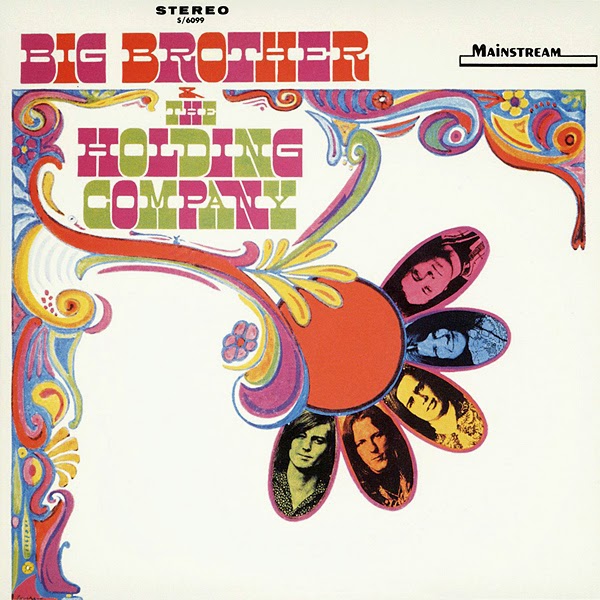
Big Brother & The Holding Company "Big Brother & The Holding Company" (1967)

1968 + cd cover
Columbia Records
Big Brother & The Holding Company [debut]
release date: Aug. 1967
format: cd (reissue)
[album rate: 3 / 5]
producer: Bob Schad
label: Columbia Records - nationality: USA

Tracklist: A) 1. "Bye, Bye Baby" - 2. "Easy Rider" - 3. "Intruder" (3 / 5) - 4. "Light Is Faster Than Sound" 3 / 5) (tv performance) - 5. "Call On Me" (3 / 5) - *6. "Coo Coo" (4 / 5) - - B) 1. "Women Is Losers" - 2. "Blindman" - 3. "Down On Me" (3 / 5) (tv performance) - 4. "Caterpillar" (3 / 5) - 5. "All Is Loneliness" - *6. "The Last Time"
*Bonus tracks on 1968 reissue

Studio debut album released by Big Brother & The Holding Company originally released on Mainstream Records. The band formed in 1965 on initiative of Peter Albin (bass guitar) and Sam Andrew (guitar, vocals), and initially worked as a trio after including James Gurley on guitar and vocals. After the inclusion of drummer David Getz the quartet then needed a stronger vocal and Janis Joplin was the last to join in the early summer of 1966. The album is quite typical as an early blues rock and psychedelic rock album, and some argue that it lacks really great tracks or extraordinary performances.
Perhaps Joplin is still new to rock and her voice may lack a bit of the strength you'll find on the successor and on her masterpiece Pearl (1971). The album, however, still contains fine traces of greatness, and I find that the band appears as a tight unit of American electric blues rock with a strong original vocal. The real "weakness" of the album is the poor production sound and a lack of stylistic direction. Some tracks seem inspired by British beat, whereas others are pure (original) experimental psychedelic rock compositions, but as a whole the album comes out as somewhat unfocused. The best tracks, A6 and B6, both originally released only as singles, but these were included on the '68 reissue and are both outtakes from the original recording sessions - on newer cd issues they may be enlisted after the original tracklist as tracks #11 and #12.
[ allmusic.com 3 / 5 stars ]

org. cover
Mainstream Records

14 September 2013

T. Rex "T. Rex" (1970)

T. Rex
release date: Dec. 18, 1970
format: cd
[album rate: 3 / 5] [3,08]
producer: Tony Visconti
label: Fly Records - nationality: England, UK

Track highlights: 2. "Jewel" - 3. "The Visit" - 10. "One Inch Rock"

1st studio album under the shortened name of T. Rex - the 5th studio album after forming Tyrannosaurus Rex and the second with Mickey Finn on percussion. The album follows only 9 months after A Beard of Stars (Mar. 1970) and although several 'official sites' insist on filing this as the actual debut album by T. Rex, but given the story behind the band / duo, it does appear more logical regarding it as the fifth album with Marc Bolan leading a musical project he has now named T. Rex.
The album T. Rex clearly shows the transition period of the band still playing psychedelic rock but also playing with new shorter, more simple compositions of glam rock - e.g. compare "The Visit" with "Pavillions of Sun" released as Tyrannosaurus Rex.

12 September 2013

Tyrannosaurus Rex "A Beard of Stars" (1970)

A Beard of Stars
release date: Mar. 13, 1970
format: cd
[album rate: 3 / 5] [3,14]
producer: Tony Visconti
label: Regal Zonophone Records - nationality: England, UK

Track highlights: 4. "Fist Heart Might Dawn Dart" - 5. "Pavillions of Sun" (4 / 5) [alternate version not on album] - 6. "Organ Blues" - 9. "A Beard of Stars" - 12. "Lofty Skies" - 14. "Elemental Child"

4th studio album release by Tyrannosaurus Rex and the final under the full band name, as the following album was released as a T. Rex album. Steve Peregrine Toke is here replaced with percussionist Mickey Finn. This album stands as one of two transitional albums reflecting Marc Bolan's move away from psychedelic folk and folk rock and into his heydays fused with glam rock. Tracks #1 and #14 showcases his inspiration in Jimi Hendrix (and the album features Bolan on electric guitar for the first time), and tracks #4, #5, #7, and #12 are fine (proto-)glam rock and boogie rock compositions.
[ allmusic.com 4 / 5 stars ]

Thin Lizzy "Shades of a Blue Orphanage" (1972)

Shades of a Blue Orphanage
release date: Mar. 10, 1972
format: cd (1988 RE)
[album rate: 2,5 / 5] [2,35]
producer: Nick Tauber
label: Decca / Deram Records - nationality: Ireland

Track highlights: 2. "Buffalo Gal" - 5. "Brought Down"

2nd album by Thin Lizzy follows one year after the debut and the line-up remains the same trio of Lynott, Bell and Downey. The strange title refers to two former bands: Eric Bell had started playing in 'Shades of Blue' and Phil Lynott and Brian Downey had both played together in the band 'Orphanage' before founding Thin Lizzy.
Although, the album contains a song originally only titled "Sarah" (track #5), this shouldn't be confused with the later much more famous "Sarah", included on Black Rose: A Rock Legend from 1979, which is why the 1988 cd reissue has labelled this "Sarah - Version I". They are two completely different songs and they pay tribute to two different Sarahs: Lynott's grandmother is the one he pays tribute to on this one., and with the '79-song, he has written a song to his newborn daughter. And the first song here just doesn't come anywhere close to the magnitude of his later song co-composed by Gary Moore.
Shades of a Blue Orphanage is a strange cocktail of styles, and it's still difficult to bond this with the later scope of the band. Some tracks here have psychedelic rock elements, others are influenced by folk rock or funk rock and it's as if there's no common denominator. "I Don't Want to Forget How to Jive" (track #3) is a strange rock & roll and rockabilly composition to put it mildly, which almost derails any coherency intended and you could say the same for the (only) hard rock-styled track "Baby Face" (track #6). "Chatting Today" reminds me more of Van Morrison and Them, and Lynott actually puts on a vocal that comes closer to that of Van the Man without being more than a copy. The following track "Call the Police" (track #8) could instead serve as a mild imitation of Frank Zappa & the Mothers - which of course is something different - and the title end-track is a soft rock, r&b mellow progressive (!) folk ballad, which takes confusion to another level.
No, this is not where you would want to start an intro to this later renowned Irish rock band but that said, the album contains the delicate and personal voice of Lynott, who already proves his worth as a songssmith on several tracks.
Mostly for completionists.
[ allmusic.com 3 / 5, Pitchfork 6,3 / 10 stars ]

11 September 2013

The Teardrop Explodes "Wilder" (1981)

Wilder
release date: Nov. 1981
format: cd
[album rate: 4 / 5] [3,92]
producer: Clive Langer
label: Mercury Records - nationality: England, UK

Track highlights: 1. "Bent Out of Shape" (5 / 5) - 2. "Colours Fly Away" (4 / 5) - 3. "Seven Views of Jerusalem" (4 / 5) - 5. "Falling Down Around Me" (4 / 5) - 7. "Passionate Friend" (4 / 5) - 8. "Tiny Children" (5 / 5) - 11. "The Great Dominions" (4 / 5)

2nd and final real studio release by Teardrop Explodes. In less than a year the band has been through various changes of line-ups, but here they are back to a nucleus of undisputed leader and only songwriter Julian Cope on lead vocals, guitars, bass, piano and organ, new member Troy Tate on guitar, David Balfe on keyboards and with Gary Dwyer on drums. James Eller, who played bass in the band during concerts to free Cope to concentrate on vocal parts is credited as additional personnel.
This is just great. Like the debut, it's a rather huge fusion pot of styles and genres but here it's under control and direction, and the neo-psychedelia fits nicely with what else Mr. Cope did later on. This is a rare album of the early '80s insofar that I still enjoy it. The album has so many fine tracks on it that one could easily think of it as a compilation album. I've had various favourite tracks on this release. Back then it was probably "Falling Down Around Me" and "Passionate Friend". Today, I think "Tiny Children" is a masterpiece.
The album was, however, met by poor sales and luke-warm reviews. After yet another period of internal conflicts the band was reduced to a trio of Cope, Balfe and Dwyer, and without a guitar-player, and after unsuccesful attempts of recording a follow-up album in '82, the band was dissolved in '83 after which Cope initiated his solo career.
[ allmusic.com 3 / 5 stars ]

Alt. cover

01 September 2013

The Teardrop Explodes "Kilimanjaro" (1980)

Kilimanjaro [debut]
release date: Oct. 1980
format: digital
[album rate: 3,5 / 5] [3,54]
producer: The Chameleons
label: Mercury Records - nationality: England, UK

Track highlights: 1. "Ha Ha I'm Drowning" - 2. "Sleeping Gas" - 3. "Treason" - 11. "When I Dream"

Studio debut album by British band The Teardrop Explodes, initially consisting of lead vocalist and bassist Julian Cope, guitarist Mick Finkler, keyboardist David Balfe and drummer Gary Dwyer. Up until the foundation of the band, Cope had shortly played in the trio Crucial Three together with Ian McCulloch and guitarist Peter Wylie, who should go on to establish the two successful bands Echo & The Bunnymen and The Mighty Wah!, respectively. During the recording sessions Finkler was sacked by the band (Cope) and substituted by Alan Gill, which means that Finkler is credited as guitarist on eight and Gill on three of the first issue's eleven songs. The album was issued in at least two original versions: the first with the UK cover (see below) and a second issue featuring the small hit song "Reward" and five songs featuring Gill and six with Finkler. Two songs are substituted with new compositions for the second issue, which has a rather different running order.
I only came across the album some four years after its release, and long after the great Wilder album. I don't think Kilimanjaro has the same greatness as the follow-up, but it still contains some fine compositions. The style is more new wave-shaped on this one, although horns are ever-present, and the general impression is a style that is too mixed up and pointing in all directions. For some reason the album is enlisted in "1001 Albums You Must Hear Before You Die".
New guitarist Alan Gill left the band by the end of the year and was replaced by Troy Tate.
[ allmusic.com 4,5 / 5 stars ]

UK cover

26 February 2013

"Bold as Love" (Live in LA) - John Mayer

John Mayer
"Where the Light Is: John Mayer Live in Los Angeles" (2008) [this version]
 studio version from "Continuum" (2006)
[Jimi Hendrix cover]

Jimi Hendrix "Axis: Bold as Love" (1967)

Axis: Bold as Love
release date: Dec. 1, 1967
format: cd
[album rate: 4 / 5]

Track highlights: 3. "Spanish Castle Magic" - 4. "Wait Until Tomorrow" - 6. "Little Wing" - 7. "If 6 Was 9" - 9. "Castles Made of Sand" - 11. "One Rainy Wish"13. "Bold as Love"

2nd studio album by The Jimi Hendrix Experience released only six month following the debut. Except for track #10 (by Noel Redding) all tracks are credited Jimi Hendrix, and apparently released prematurely to satisfy his contractual obligations. The album is enlisted in "1001 Albums You Must Hear Before You Die".